
In industrial automation, repeatability isn’t just a feature — it’s a necessity.
When you’re running thousands of parts every day, even a 1 mm shift or 1-second delay can cause serious quality issues or rejections.
That’s exactly the problem one of our customers — a textile machine builder in Tiruppur — faced before switching to our electric motion units.
Let me tell you what happened.
The Challenge
Their old setup used pneumatic cylinders to move components back and forth in a dyeing machine. For the first few cycles, it worked fine. But as the air pressure fluctuated and the cylinder got warm, the movement started to vary.
Sometimes it stopped 2 mm ahead.
Sometimes it didn’t retract fully.
The machine operator had to keep adjusting the sensors and valves all day.
Result?
Inconsistent product quality and high fatigue for operators.
Our Solution
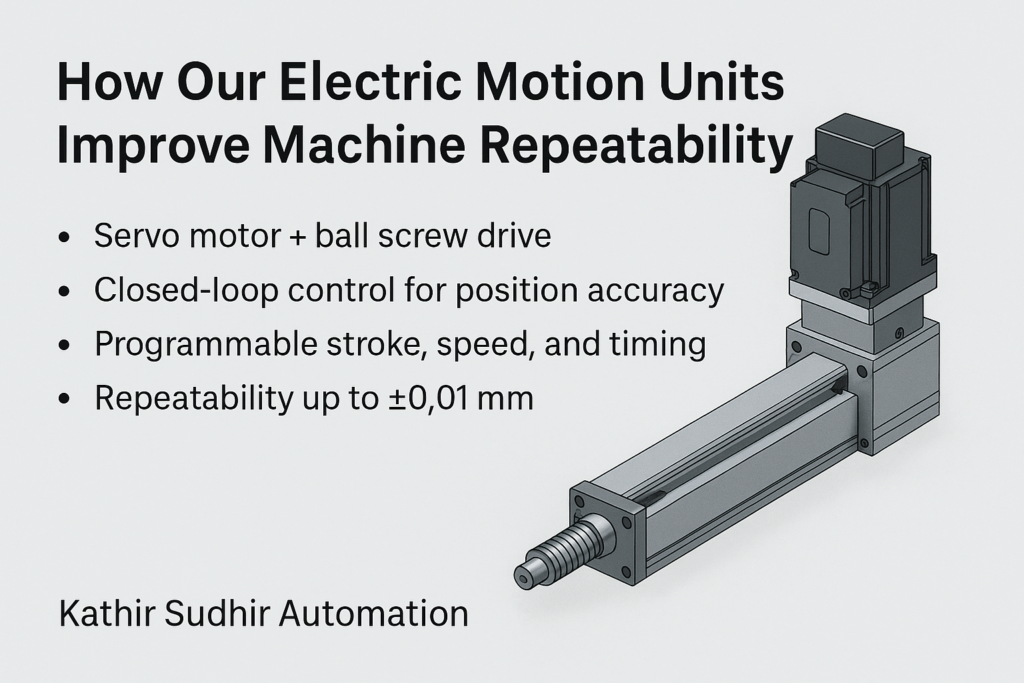
We replaced their pneumatic system with our electric motion unit – built with:
- Servo motor + ball screw drive
- Closed-loop control for position accuracy
- Programmable stroke, speed, and timing
- Repeatability up to ±0.01 mm
We integrated the unit with their existing PLC panel — no major changes. Within a day, they were running production.
What Changed?
The difference was immediate.
- The machine moved to exactly the same position every time
- No more trial-and-error adjustments
- Product quality became consistent across batches
- Operator effort reduced drastically
Their repeatability went from ±2 mm to ±0.01 mm — and they’ve been running the same unit for over a year now without a single failure.
Why Electric Motion Wins in Repeatability
Unlike air or hydraulic systems, electric motion doesn’t depend on fluid pressure, temperature, or external factors.
The servo motor knows where it needs to go — and it goes there. Every time. Without fail.
This is what makes electric motion the best choice for applications like:
- Assembly and fitting lines
- CNC automation
- Packaging machines
- Inspection and testing stations
- Pick-and-place mechanisms
Final Thought
If your machine gives different results in every cycle, it’s not just a hardware issue — it’s a repeatability issue.
And our electric motion units are built specifically to solve that.
FAQ
1. What is repeatability in industrial automation?
Repeatability refers to a machine’s ability to return to the exact same position or perform the same movement accurately in every cycle. In high-volume production, even a ±1 mm variation can cause quality defects, alignment issues, or product rejection.
2. Why are pneumatic cylinders less accurate over time?
Pneumatic cylinders depend on air pressure, which fluctuates due to:
- Temperature changes
- Air leaks
- Compressor variations
- Load differences
As pressure varies, stroke length and stopping position change — reducing repeatability and increasing manual adjustments.
3. How does an electric motion unit improve repeatability?
Electric motion systems use:
- Servo motors
- Ball screw drives
- Closed-loop feedback control
This ensures the system knows its exact position at all times and corrects deviations instantly — achieving repeatability up to ±0.01 mm.
4. What is closed-loop control in servo systems?
Closed-loop control uses a feedback device (encoder) to continuously monitor position and correct errors in real time. If the motor moves slightly off target, the system automatically adjusts — ensuring consistent positioning in every cycle.
5. Can electric motion units replace pneumatic cylinders without changing the PLC?
Yes. In most cases, electric motion units can be:
- Integrated into existing PLC panels
- Configured using digital I/O or communication protocols
- Installed without major wiring or control changes
This makes upgrades fast and cost-effective.
6. What industries benefit most from electric motion repeatability?
Electric motion systems are ideal for:
- Assembly lines
- CNC automation
- Packaging machines
- Textile machinery
- Pick-and-place systems
- Inspection and testing stations
Any process requiring precise and repeated positioning benefits significantly.
7. How much repeatability improvement can electric motion provide?
Typical pneumatic systems offer repeatability of around ±1 mm to ±2 mm. High-quality electric motion systems can achieve ±0.01 mm, making them 100–200 times more precise in positioning accuracy.
8. Does electric motion reduce operator fatigue?
Yes. Since electric motion eliminates:
- Constant sensor adjustments
- Valve tuning
- Manual recalibration
Operators don’t need to intervene frequently, reducing fatigue and increasing productivity.
9. Are electric motion systems affected by temperature like pneumatics?
Electric motion systems are far less affected by temperature compared to pneumatic or hydraulic systems because they do not rely on fluid pressure for positioning accuracy. Servo-based systems maintain consistent performance across varying environmental conditions.
10. Is electric motion more reliable than pneumatic systems for long-term use?
In precision applications, yes.
Electric systems:
- Have fewer variables affecting movement
- Offer programmable control
- Provide consistent repeatability
- Reduce wear caused by pressure fluctuations
With proper installation and maintenance, they can operate for years with stable performance.
0 responses to “How Our Powerful Electric Motion Units Improve the Machine Repeatability”