
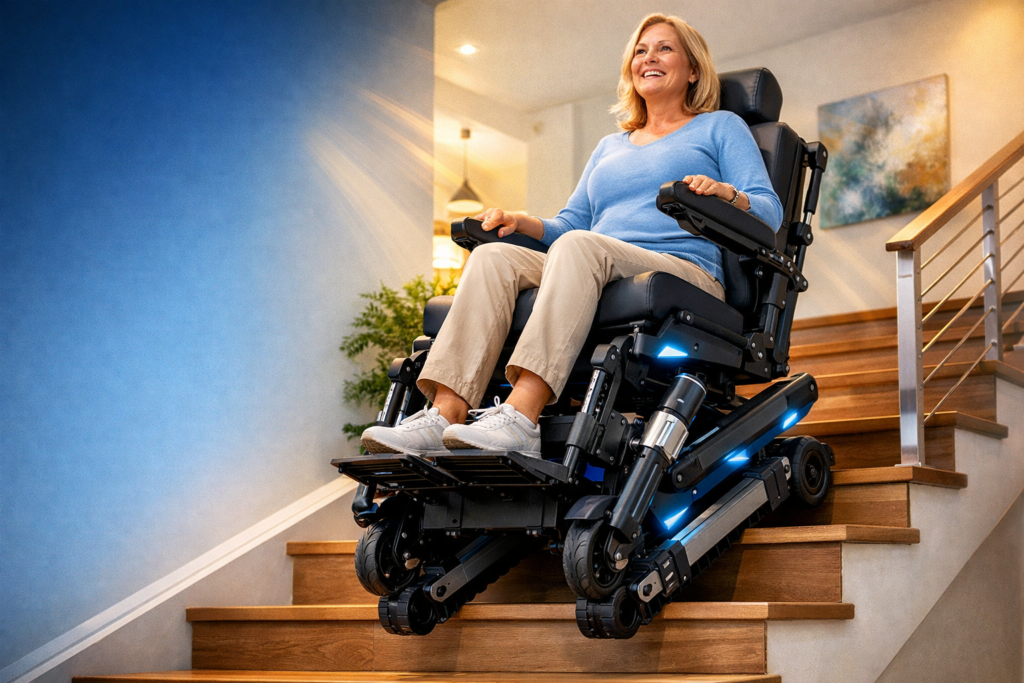
Recently, I saw an incredible innovation — a stair-climbing wheelchair that allows a person to move up and down stairs while staying seated. At first, it looked simple. However, the technology behind it is powerful. More importantly, it gives freedom back to the elderly, the sick, and differently-abled people. This is what real innovation looks like. It solves real problems. At the same time, it restores dignity and independence. But how does it actually work? The answer lies in a small yet powerful device — the linear actuator.
What Is a Linear Actuator?
Simply put, a linear actuator converts motor rotation into straight-line motion. In other words, it pushes and pulls parts of the chair smoothly and safely. Because of this, the chair can adjust positions and climb stairs with control and precision.
Main Areas Where Linear Actuator Are Used
In an electric stair care chair, linear actuators are mainly used in two areas:
- The seat assembly
- The motion and stability system
Let’s look at each one.
1. Seat Assembly – For Comfort and Easy Use
First of all, comfort is very important. Therefore, actuators are placed inside different seat parts.
Backrest Adjustment
The actuator changes the recline angle. As a result, the user can sit upright or lean back comfortably.
Footrest Movement
It also raises or lowers the footrest. This helps support the legs properly. In addition, it reduces pressure and improves comfort.
Headrest and Armrest Adjustment
In advanced models, actuators adjust the headrest and armrests too. Consequently, users get better body support.
Seat Tilt and Height Control
Furthermore, the seat can tilt or change height. This helps users move from sitting to standing more safely. It also makes transfers easier. Because of these features, users feel more independent and secure.
2. Motion and Stability – For Climbing Stairs Safely
Now, let’s talk about stair climbing. In stair-climbing models, actuators play a critical role. Without them, safe stair movement would not be possible.
Wheel and Leg Position Control
Multiple actuators adjust the wheels or support legs individually. As a result, the chair adapts to each step. At the same time, the seat stays level. Therefore, the user remains stable and balanced.
Rail-End Automation (For Traditional Stair Lifts)
In rail-based systems, actuators may open or close the end section of the rail. This saves space when the chair is not in use. Overall, these movements are smooth, quiet, and controlled. Most importantly, they increase safety.
Tailor-Made Mobility Solutions
Every person has different needs. Therefore, stair care chairs can be customized. For example, actuator strength, stroke length, and speed can be adjusted. As a result, the system matches different body types and weight capacities. Whether for home use or hospitals, solutions can be designed accordingly.
Flexible and User-Friendly Control Systems
Ease of use is equally important.
Therefore, actuators connect with simple control systems such as:
- Joysticks
- Remote controls
- Push-button panels
In addition, many systems include safety sensors. Because of this, movement stays controlled and secure. Even caregivers can operate the chair easily.
Quality, Safety, and Medical Compliance
Above all, safety comes first. High-quality linear actuators offer:
- Overload protection
- Anti-backdrive safety
- Quiet operation
- Long service life
Moreover, medical-grade systems follow strict safety standards. As a result, users can trust the equipment every day.
Technology That Restores Freedom
In conclusion, an electric stair care chair is more than a machine. It represents thoughtful engineering. More importantly, it represents empathy. Because of linear actuators, people can move freely in spaces that once limited them. And finally, this is the kind of innovation we should encourage – technology that truly changes lives.
0 responses to “Where Linear Actuator Used in the reliable Stair Care Chair?”