
Bar feeders using electric actuator are changing how CNC machines handle raw materials. Instead of using hydraulic or pneumatic systems, manufacturers now prefer electric solutions. As a result, production becomes more precise, cleaner, and easier to control. Most importantly, electric actuators help reduce downtime and operating costs. Traditionally, bar feeders relied on air or oil pressure. However, these systems require pumps, hoses, and frequent maintenance. In contrast, electric actuators use motors to create smooth and accurate linear motion. Because of this, they are ideal for modern automated machining environments.
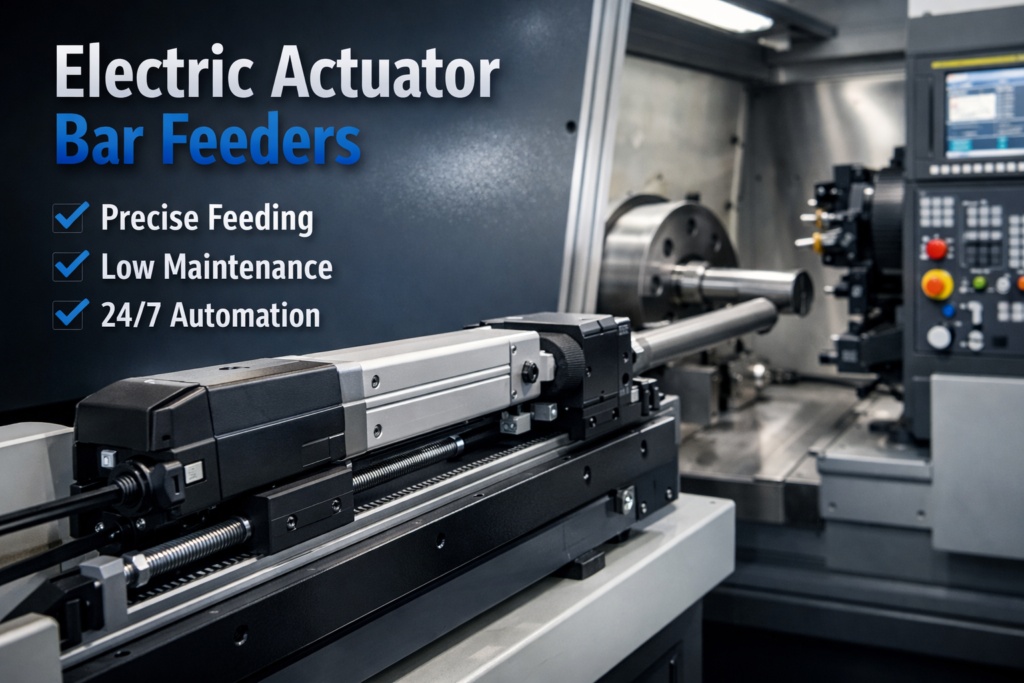
How Electric Actuator Improve Bar Feeding
Electric actuators convert rotational motor movement into straight-line force. Therefore, bars can be pushed into CNC lathes with exact positioning. At the same time, feeding speed can be adjusted easily. This improves consistency during long production runs.
Moreover, electric bar feeders support height adjustment and precise material alignment. As a result, machine setup time is reduced. In addition, repeatability improves, which helps lower rejection rates.
Key Advantages of Electric Actuator–Based Bar Feeders
Better Performance and Accuracy
First, electric actuators provide fine control over speed and position. Because of this, feeding errors are minimized. Over long shifts, this leads to fewer defects and better surface finish.
Higher Efficiency and Reliability
Unlike hydraulic systems, electric actuators use power only when they move. Therefore, energy use drops significantly. In addition, there are no oil leaks or air losses. This means less maintenance and fewer unexpected stoppages.
Easy Integration with Automation Systems
Electric bar feeders work well with PLCs and smart controllers. For example, solutions from SMC support simple programming and diagnostics. As a result, integration into Industry 4.0 environments becomes easier.
Space Saving and Clean Design
Because electric actuators are compact, they take up less floor space. Furthermore, the clean design makes them suitable for modern production areas.
Actuator Solutions for Bar Feeders
Actuator solutions for bar feeders are flexible and modular. Depending on the application, users can choose different stroke lengths, speeds, and load capacities. For instance, electric actuators from Kathir Sudhir Automation India Pvt Ltd are widely used for reliable linear motion. Additionally, these actuators can be controlled using a PLC or an integrated controller. This makes them suitable for both small workshops and large CNC facilities.
Comparison: Electric vs Traditional Bar Feeders
| Aspect | Electric Actuator | Hydraulic | Pneumatic |
|---|---|---|---|
| Accuracy | High | Medium | Low |
| Energy Use | Low | High | Medium |
| Maintenance | Very Low | High | Medium |
| Clean Operation | Yes | No | Mostly |
| Automation Ready | Yes | Limited | Limited |
Step-by-Step: Using Electric Actuator in Bar Feeders
- First, select the actuator based on bar weight and length
- Next, mount it on the feeder push mechanism
- Then, connect it to a PLC or controller
- After that, set speed and stroke values
- Finally, test and start automated feeding
Quick Checklist Before Selection
- Required pushing force
- Stroke length and speed
- Continuous duty capability
- Built-in safety features
Example Application
A CNC shop feeding long steel bars replaced pneumatic feeders with electric actuators. As a result, energy use dropped by nearly 30%. At the same time, feeding errors were almost eliminated. Because of this, the shop could run unmanned night shifts.
FAQs: People Also Ask
1. What are electric bar feeders used for?
They feed raw bars into CNC machines with high accuracy.
2. Are electric bar feeders better than pneumatic ones?
Yes, they offer better control and lower maintenance.
3. Do they support PLC control?
Yes, most models are PLC compatible.
5. Are they suitable for small CNC shops?
Yes, they save space and simplify automation.
6. What materials can be fed using electric bar feeders?
Electric bar feeders can handle steel, aluminum, brass, and other metals. They work with both long and short bars. Feeding remains smooth and stable. This helps improve machining quality.
7. Do electric actuator bar feeders reduce maintenance?
Yes, maintenance is much lower compared to hydraulic or pneumatic systems. There is no oil, air hose, or pump. Fewer parts mean fewer failures. This reduces downtime and service costs.
8. What problem do electric bar feeders solve?
They reduce feeding errors and machine stoppages. They also remove the need for air or oil systems.
9. Can electric bar feeders improve machining accuracy?
Yes, precise control keeps the bar in the correct position. This leads to better machining results.
10. Do electric bar feeders save factory space?
Yes, their compact design needs less floor space. This helps keep the shop layout clean.
Final Thoughts
In summary, bar feeders using electric actuators offer precision, efficiency, and reliability. More importantly, they support unmanned production and smart manufacturing. For CNC operations looking to upgrade, electric actuator–based bar feeders are a future-ready solution.
0 responses to “Bar Feeders Using the Powerful Electric Actuator for Smarter Automation”