
Hidden TV lifts use linear actuator to convert electrical power into smooth linear motion that raises, lowers, or flips a TV on demand. As a result, the TV stays completely hidden when not in use. Moreover, this system improves space utilization and interior aesthetics. Therefore, linear actuators are the preferred choice for modern motorized TV lift solutions.
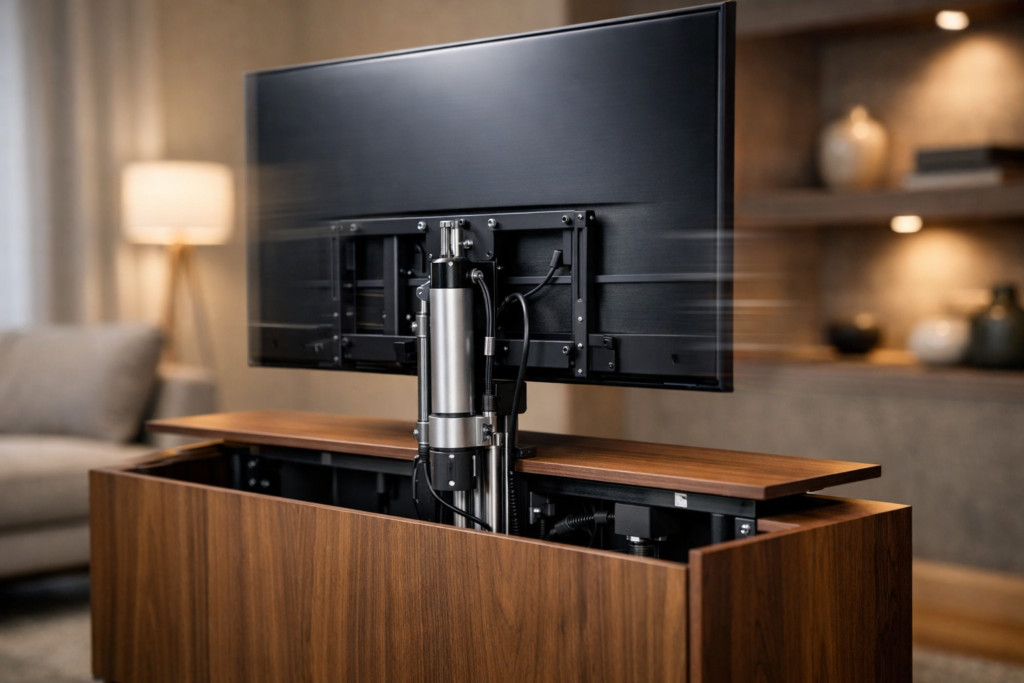
What Is a TV Lift Motion System?
A TV lift motion system is a mechanical setup that moves a television in a controlled direction. Typically, it allows vertical or angular movement. Because stability is critical, guide rails are always used. In addition, the system ensures smooth and repeatable motion every time.
Different Types of Linear Motion Actuators
Linear actuators come in multiple variations. Each type serves a specific purpose.
- DC Linear Actuators (12V / 24V) – Most common and cost-effective
- Heavy-Duty Actuators – Ideal for large or commercial TVs
- Smart Linear Actuators – Work with remotes, RF, or mobile apps
- High-Speed or High-Load Models – Selected based on lift style
Consequently, choosing the right actuator improves both safety and performance.
How to Design a Motorized TV Lift Mechanism
First, decide how the TV should move. Next, calculate the TV’s weight and height. Then, select an actuator with extra load capacity. After that, add guide rails for stability. Finally, integrate the controller and power supply. As a result, the lift operates smoothly and safely.
Common Lift Styles Used in TV Mechanisms
There are three popular lift styles. Each one suits a different space.
- Pop-Up TV Lift – TV rises from a cabinet or console
- Drop-Down TV Lift – TV descends from a ceiling void
- Flip-Down TV Lift – TV rotates down from shallow ceilings
Therefore, space availability determines the best option.
Required Components for a TV Lift System
To build a reliable TV lift, you will need the following:
- Linear actuator (stroke length 1–2 inches longer than TV height)
- Heavy-duty guide rails or drawer slides
- 12V or 24V power supply
- Controller with remote or app support
- Mounting brackets and TV mount
Without these parts, the system will lack stability and control.
Step-by-Step: Building a Pop-Up TV Lift
First, build a vertical sliding frame inside the cabinet.
Then, install guide rails on both sides.
Next, mount the actuator base at the cabinet bottom.
After that, connect the actuator rod to the TV plate.
Finally, wire the controller and test the movement without the TV.
Once tested, mount the TV securely.
Key Features and Technology Behind TV Lifts
Modern TV lift systems include advanced features.
- Built-in limit switches for automatic stop
- Quiet DC motors for smooth operation
- Anti-backdrive mechanisms for safety
- Smart control compatibility
As a result, the lift performs reliably over time.
Advantages and Disadvantages of TV Lift Systems
Advantages
- Saves space
- Enhances interior design
- Provides automation and convenience
Disadvantages
- Higher initial cost
- Requires precise alignment
- Needs continuous power supply
However, the benefits usually outweigh the drawbacks.
Comparison of TV Lift Types
| Lift Type | Space Requirement | Best Use | Difficulty |
|---|---|---|---|
| Pop-Up | Cabinet depth | Homes | Medium |
| Drop-Down | Ceiling void | Hotels | High |
| Flip-Down | Shallow ceiling | Compact rooms | Medium |
Key Application Areas
TV lift systems are widely used today.
- Smart homes
- Luxury bedrooms
- Hotel rooms
- Conference rooms
- Yachts and RVs
Therefore, demand continues to grow.
Installation Checklist
Before final installation, confirm the following:
- Actuator load capacity verified
- Guide rails aligned correctly
- Limit switches tested
- Smooth movement without TV
- Wiring secured safely
This checklist prevents failures later.
Real-Life Examples
For example, TVs can rise from bedroom footboards. Similarly, boardroom TVs emerge from tables. In hotels, TVs often drop down from ceilings.
Frequently Asked Questions (FAQs)
1. How does a linear actuator lift a TV?
It converts electrical energy into linear motion that pushes or pulls the TV.
2. What stroke length should I choose?
Select a stroke 1–2 inches longer than the TV’s vertical height.
3. Is one actuator enough for a TV lift?
Yes, if its load capacity exceeds the TV weight with a safety margin.
4. Are TV lift systems noisy?
No. Most DC actuators operate quietly.
5. Do actuators stop automatically?
Yes. Built-in limit switches stop motion at full extension or retraction.
6. Are guide rails necessary?
Absolutely. Actuators provide force, not lateral stability.
7. Can I build a DIY TV lift?
Yes, with proper measurements and components.
8. What power supply is required?
Usually 12V or 24V DC, depending on the actuator.
9. Can TV lifts work with smart homes?
Yes. Many controllers support smart integration.
10. Are hidden TV lifts safe?
Yes, when installed correctly and tested properly.
Final Conclusion
In conclusion, hidden TV lifts using linear actuators offer a smart and elegant solution for modern interiors. They save space while adding automation and luxury. With proper planning and the right components, these systems deliver long-term reliability. Therefore, linear actuator-based TV lifts are an excellent investment for both homes and commercial spaces.
0 responses to “How hidden TV lifts using the Innovative linear actuator”