
Film production depends on smooth camera movement to create emotional impact, dramatic tension, and immersive storytelling. Linear actuators help filmmakers achieve highly controlled camera sliding, tilting, lifting, and motion repeatability with precision that manual systems struggle to match.
From cinematic tracking shots to automated jib tilting, modern camera motion systems using linear actuators deliver vibration-free movement, programmable control, and repeatable performance for professional filmmaking.
Overview of Camera Motion Systems Using Linear Actuators
Camera motion systems using linear actuators are advanced electromechanical setups designed to move cameras smoothly and accurately during filming. These systems convert rotary motor movement into controlled linear motion.
In the film industry, camera movement directly affects visual storytelling. Smooth movement improves scene quality, enhances cinematic feel, and removes unwanted vibration or instability.
Key Aspects
- Smooth and programmable camera movement
- High precision positioning
- Repeatable motion paths for VFX work
- Stable tilting and lifting performance
- Remote operation capability
- Heavy payload support for cinema cameras
- Reduced operator fatigue
Common Camera Movements Powered by Linear Actuators
| Camera Motion | Purpose | Linear Actuator Function |
|---|---|---|
| Slider Movement | Tracking shots | Pushes carriage smoothly |
| Jib Tilting | Dynamic vertical angles | Controls tilt angle |
| Dolly Motion | Cinematic movement | Drives camera platform |
| Pan and Tilt | Subject tracking | Automated positioning |
| Motion Control | Repeatable VFX shots | Precision synchronization |
| Crane Operation | Large scene coverage | Controlled lifting motion |
How Linear Actuators Work in Camera Systems
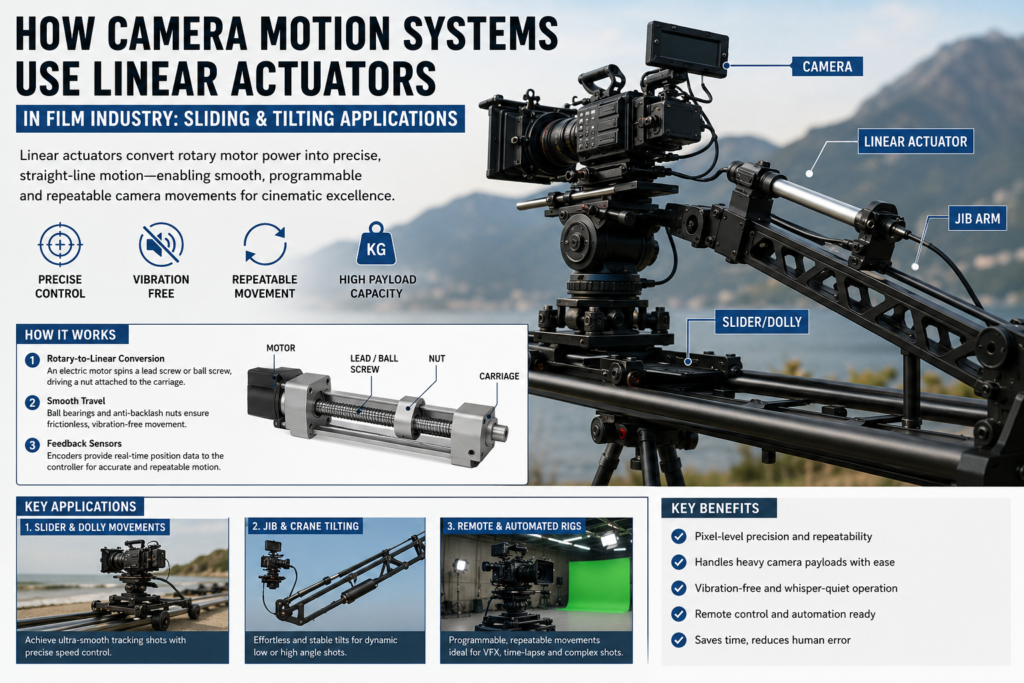
Camera motion systems utilizing linear actuators transform filmmaking by delivering flawlessly smooth, programmable, and repeatable movements. In applications like camera sliding and jib tilting, motorized actuators convert rotary motor power into precise, straight-line force.
This allows operators to execute dynamic shots without human error or vibration.
Rotary-to-Linear Conversion
An electric motor spins a lead screw or ball screw inside the actuator. The threaded shaft drives a nut connected to the moving carriage.
As the screw rotates:
- The carriage moves forward or backward
- The camera platform glides smoothly
- Positioning remains accurate throughout movement
Smooth Travel Mechanism
Modern actuators use:
- Ball bearings
- Anti-backlash nuts
- Precision guide rails
- Low-friction surfaces
These components reduce vibration and eliminate unwanted movement.
Feedback Sensors and Motion Control
Advanced actuators include:
- Optical encoders
- Hall effect sensors
- Servo feedback systems
These act like a positioning GPS for the motion system.
The controller constantly receives:
- Speed data
- Position data
- Travel distance information
- Load feedback
This enables precise camera movement control.
How It Is Used in Film Industries
Linear actuators are widely used in modern film production for controlled camera movement.
1. Slider and Dolly Movements
Rather than manually pushing heavy camera dollies, filmmakers use motorized actuator systems.
Benefits include:
- Uniform camera tracking
- Consistent speed
- Slow cinematic movement
- Smooth acceleration
- Better scene repeatability
This is especially useful in:
- Product commercials
- Slow-motion scenes
- Dramatic reveals
- Interview production
2. Jib and Crane Tilting
Linear actuators push and pull the camera head during jib movement.
This allows:
- Smooth upward tilting
- Downward cinematic angles
- Stable heavy camera handling
- Wind resistance support
The actuator is positioned between:
- Crane arm
- Camera mounting head
High-torque actuators maintain stability even with large cinema rigs.
3. Remote and Automated Camera Rigs
For complex scenes, programmable motion systems use linear actuators to repeat identical camera paths.
These systems are essential for:
- Visual effects production
- CGI compositing
- Time-lapse photography
- Green screen work
- Product showcase videos
4. Robotic Camera Positioning
Modern virtual production studios integrate robotic linear actuators with AI-based camera tracking.
This improves:
- Real-time motion synchronization
- Automated subject tracking
- Multi-camera coordination
- Studio workflow efficiency
Required Components for Camera Motion Systems
| Component | Function |
|---|---|
| Linear Actuator | Creates linear movement |
| Servo Motor | Controls precise motion |
| Motion Controller | Executes programmed movement |
| Guide Rails | Maintains smooth travel |
| Power Supply | Delivers operating voltage |
| Encoder Sensors | Provides feedback data |
| Camera Mount | Secures camera rig |
| Wireless Remote | Enables remote control |
| Control Software | Programs motion paths |
Recommended Actuator Specifications
| Specification | Typical Requirement |
|---|---|
| Stroke Length | 30mm to 1200mm |
| Load Capacity | 20kg to 200kg |
| Speed | 4mm/s to 160mm/s |
| Voltage | 12V, 24V |
| Protection Rating | IP43 to IP67 |
Key Features and Technology Trends
Key Features
- Silent operation
- Programmable movement
- Remote control support
- Compact design
- Precision repeatability
- High payload handling
- Low vibration movement
- Multi-axis synchronization
Latest Technology Trends
AI-Based Camera Tracking
AI systems automatically adjust camera position using actuator feedback.
Wireless Motion Programming
Operators control motion systems using smartphones or wireless panels.
Servo-Based Precision Systems
Servo actuators provide ultra-smooth cinematic motion.
Virtual Production Integration
Linear actuators integrate with LED wall studios and virtual camera systems.
Lightweight Carbon Fiber Rigs
Modern camera rigs combine lightweight structures with compact actuators.
Advantages and Disadvantages
Advantages
| Advantages | Benefits |
|---|---|
| Pixel-Level Precision | Accurate repeated movement |
| Vibration-Free Motion | Better cinematic quality |
| Heavy Payload Support | Handles cinema camera rigs |
| Automation Capability | Saves production time |
| Remote Operation | Safer complex shots |
| Smooth Tilting | Stable camera movement |
| Programmable Paths | Perfect VFX synchronization |
Disadvantages
| Disadvantages | Impact |
|---|---|
| Higher Initial Cost | Professional systems are expensive |
| Technical Setup | Requires programming knowledge |
| Power Dependency | Needs reliable power supply |
| Maintenance Requirement | Sensors and rails need servicing |
| Learning Curve | Operators require training |
Operations and Functions
Main Operational Functions
- Camera sliding
- Tilt adjustment
- Height positioning
- Motion synchronization
- Automated movement looping
- Speed control
- Repeat motion execution
Motion Programming Workflow
- Define movement path
- Configure actuator speed
- Set start and end positions
- Program acceleration curve
- Run test motion
- Synchronize with camera recording
- Execute final shot
Steps to Follow When Setting Up a Camera Motion System
Step 1: Select the Right Actuator
Choose based on:
- Camera weight
- Required speed
- Travel distance
- Mounting style
Step 2: Install Guide Rails
Ensure rails are:
- Level
- Rigid
- Vibration-free
Step 3: Mount the Camera Platform
Secure the camera using:
- Locking brackets
- Stabilized mounts
- Balanced payload positioning
Step 4: Connect Motion Controller
Configure:
- Speed profiles
- Motion range
- Safety limits
Step 5: Calibrate Position Feedback
Use sensors and encoders for accurate positioning.
Step 6: Perform Motion Testing
Check:
- Smooth travel
- Noise levels
- Repeatability
- Camera stability
Key Prevention Techniques for Stable Camera Motion
Prevent Vibration
- Use anti-backlash actuators
- Install dampers
- Tighten all mounts
Prevent Overloading
- Follow payload ratings
- Balance camera weight properly
- Use reinforced mounts
Prevent Motion Errors
- Calibrate sensors regularly
- Update controller firmware
- Test motion paths before shooting
Prevent Environmental Damage
- Use IP-rated actuators outdoors
- Protect against dust and rain
- Avoid overheating conditions
Compliance and Best Practices
Industry Best Practices
- Use professional-grade motion controllers
- Follow payload safety limits
- Maintain cable management
- Perform regular calibration
- Use backup power systems
Safety Recommendations
- Install emergency stop switches
- Use overload protection
- Secure all moving components
- Train operators properly
Compliance Standards
Professional systems often follow:
- CE certification
- RoHS compliance
- ISO manufacturing standards
- Electrical safety standards
Pro Tip for Filmmakers
Use servo-driven linear actuators with encoder feedback for cinematic motion control. This setup provides smoother acceleration, highly repeatable movement, and better synchronization for VFX production.
For outdoor shoots, select actuators with IP65 or higher protection ratings to avoid dust and moisture damage.
Examples of Film Industry Applications
Commercial Production
Product videos use precise slider motion for dramatic close-up shots.
Music Videos
Automated camera tilting creates dynamic movement synchronized with performance.
Feature Films
Motion control rigs execute repeatable scenes for visual effects compositing.
Documentary Filming
Portable actuator sliders provide stable movement in outdoor environments.
Virtual Production Studios
LED wall environments use synchronized camera motion systems for immersive scene creation.
Comparison Table: Manual vs Linear Actuator Camera Systems
| Feature | Manual Camera Systems | Linear Actuator Systems |
|---|---|---|
| Precision | Moderate | Extremely High |
| Repeatability | Low | Excellent |
| Vibration Control | Limited | Superior |
| Automation | No | Yes |
| Remote Operation | Limited | Full Support |
| Heavy Camera Support | Difficult | Easy |
| Motion Programming | Not Possible | Fully Programmable |
| Cinematic Smoothness | Operator Dependent | Consistent |
People Also Ask
1. How do linear actuators enhance camera motion systems in film production?
Linear actuators provide smooth, programmable, and repeatable camera movement. They reduce vibration and improve cinematic shot quality.
2. What are the fundamental principles of linear actuator use in film camera motion?
Linear actuators convert rotary motor motion into straight-line movement using lead screws or ball screws. This creates precise camera positioning and controlled movement.
3. What companies offer camera motion systems with linear actuators for cinematic use?
Companies like kathir sudhir Automation, and several industrial actuator manufacturers provide cinematic motion systems.
4. How do linear actuators enhance precision in camera tilting for cinematography?
Actuators provide accurate push-pull movement with encoder feedback, allowing smooth and stable camera tilting without sudden jerks.
5. Which is the best camera motion control systems using linear actuators for tilt and pan shots?
Servo-driven motion control systems with encoder feedback are widely preferred for professional tilt and pan cinematography.
6. Explain the different types of linear actuators suitable for film industry camera movement.
Electric linear actuators, servo actuators, ball screw actuators, rod-style actuators, and track actuators are commonly used in film production.
7. Where to buy professional linear actuator camera rigs for filmmaking in India?
Professional actuator systems are available through industrial automation suppliers, filmmaking equipment distributors, and specialized actuator manufacturers.
8. Where can I find reputable suppliers of linear actuators for film production in India?
You can find suppliers through industrial automation companies, motion control solution providers, and actuator-focused online stores.
9. Explain the role of linear actuators in smooth camera tilting for film shoots.
Linear actuators maintain controlled push and pull force during camera tilt movement. This prevents vibration and improves cinematic smoothness.
Conclusion
Linear actuators have become an essential technology in modern filmmaking. They provide smooth, programmable, and repeatable camera movement for cinematic production.
From camera sliders and jib tilting systems to advanced robotic motion control rigs, these actuators improve precision, stability, and production efficiency.
As virtual production, AI-assisted cinematography, and automated filmmaking continue growing, linear actuator camera systems will play an even larger role in delivering high-quality cinematic visuals.
Filmmakers looking for precision motion control should focus on servo-driven actuators, feedback-enabled systems, and professional motion controllers to achieve the best cinematic results.
0 responses to “How Camera Motion Systems Using Linear Actuators Create Smooth Cinematic Movement in Film Production”