
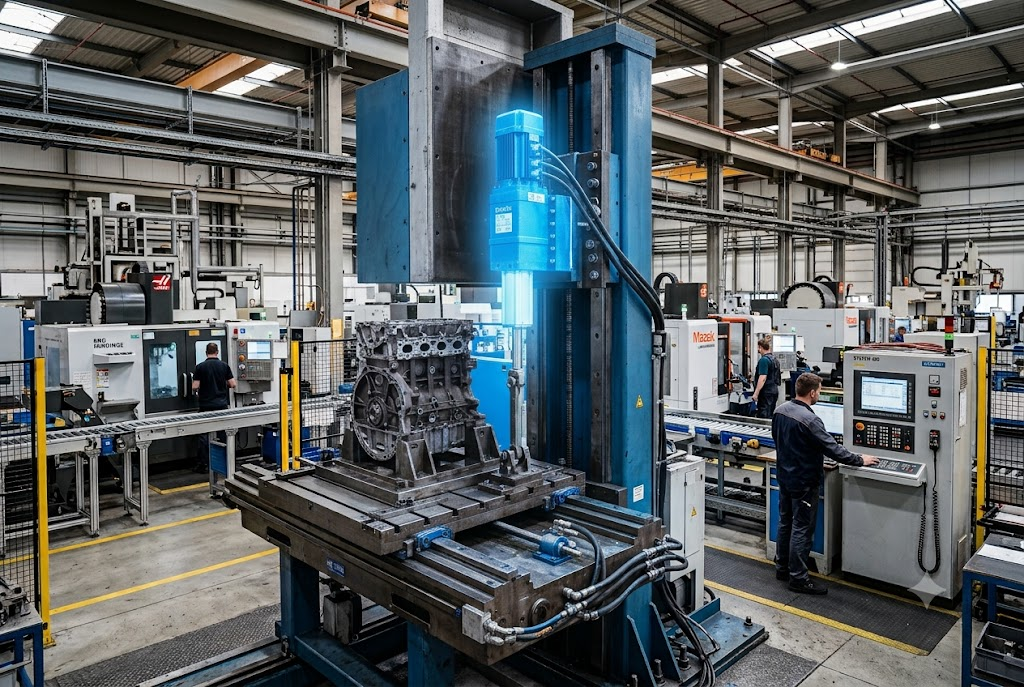
Industrial Linear Actuator systems are often used to provide controlled movement for lifting, lowering, pushing, pulling, and positioning heavy components. Manual mechanisms take more time and require operator effort. Hydraulic and pneumatic systems also need additional infrastructure such as pumps, valves, compressors, and piping.
An Industrial Linear Actuator provides a compact electric solution for these applications. It converts electrical energy into controlled linear movement and enables automated lifting and positioning. These devices are widely used to lift equipment, adjust machine components, and position fixtures. They also serve conveyors, platforms, and material-handling systems.
What Is a Linear Actuator?
A linear actuator is an elector mechanical device designed to create straight-line movement. When power is supplied to the actuator, its motor drives a mechanical mechanism such as a screw, causing the actuator rod to extend or retract.
This movement allows a machine to:
- Lift and lower equipment
- Push or pull components
- Adjust machine height
- Position fixtures
- Open and close machine covers
- Move platforms and mechanisms
- Control mechanical gates and flaps
Electric actuators are available in different force, stroke, speed, voltage, and mounting configurations to suit different industrial requirements.
How Linear Actuators Support Industrial Lifting
Industrial lifting systems require controlled movement and sufficient force to handle the required load. A properly selected actuator provides repeatable movement without requiring manual lifting.
Common lifting applications include:
- Industrial lift tables
- Material handling equipment
- Adjustable workstations
- Conveyor height adjustment
- Machine platforms
- Automated lifting mechanisms
- Loading and unloading systems
- Industrial equipment adjustment
For heavier or wider loads, multiple actuators can be synchronized to distribute the load and maintain balanced movement.
Linear Actuator for Industrial Positioning
Positioning is another important application for electric linear actuators. Machines often need components to move to a specific position before a process starts.
A linear actuator helps control:
- Tool positioning
- Fixture adjustment
- Conveyor positioning
- Sensor positioning
- Machine height adjustment
- Guide positioning
- Material handling mechanisms
- Automated alignment systems
Position feedback options can further improve positioning control when the application requires monitoring of actuator movement.
Key Benefits of Electric Linear Actuators
1. Controlled Linear Movement
The actuator provides controlled extension and retraction. This helps machines perform consistent lifting and positioning operations.
2. Easy Automation
Linear actuators work with switches, remote controls, relays, and other control systems. This makes them suitable for automated industrial equipment.
3. Compact Design
An electric actuator combines the motor and mechanical drive into a compact unit. This helps simplify machine integration where installation space is limited.
4. Reduced Manual Operation
Automating lifting and positioning reduces repetitive manual work and improves operator convenience.
5. Precise Adjustment
The actuator provides controlled movement for applications where machine components need repeatable positioning.
6. Low Maintenance
Electric systems do not require compressed air or hydraulic fluid lines. This helps reduce supporting equipment and maintenance requirements compared with pneumatic or hydraulic systems in suitable applications.
Important Specifications to Consider
Choosing the correct actuator is important for safe and reliable operation.
Force
Calculate the total load and the force required to move it. Consider the load direction, friction, mechanical arrangement, and an appropriate safety margin.
Stroke Length
Stroke determines how far the actuator moves. Select a stroke that matches the required lifting or positioning distance.
Speed
Select actuator speed based on the required cycle time. A high-speed actuator suits applications requiring quick adjustment, while slower movement is useful where controlled positioning is important.
Voltage
Common DC actuator options include 12V and 24V. Select the voltage according to your control system and power supply.
Mounting
Check the mounting points, actuator orientation, available installation space, and alignment before installation.
Duty Cycle
Check how frequently the actuator needs to operate. Continuous or frequent operation requires an actuator designed for the required duty cycle.
These factors directly affect actuator performance and service life.
Industrial Applications of Linear Actuators
Electric linear actuators are suitable for many industrial systems, including:
- Manufacturing machinery
- Material handling systems
- Conveyor systems
- Packaging machines
- equipment
- Assembly machines
- Industrial workstations
- Lifting platforms
- Warehouse equipment
- Automated fixtures
- Agricultural machinery
- Machine covers and access systems
Material-handling applications include lifting, height adjustment, sorting, positioning, diverting, pick-and-place.
How to Select the Right Linear Actuator
Before purchasing a linear actuator, define these requirements:
- Determine the load to be lifted or moved.
- Calculate the required actuator force.
- Determine the required stroke length.
- Select the required movement speed.
- Choose 12V or 24V based on your system.
- Check the mounting dimensions.
- Consider the operating environment.
- Check the duty cycle.
- Determine whether position feedback is required.
- Select suitable control equipment.
For vertical lifting, pay particular attention to load holding, alignment, and the mechanical structure supporting the load.
Why Choose an Electric Linear Actuator for Industrial Automation?
An electric linear actuator provides a practical way to automate lifting and positioning without complex mechanical operation. It offers controlled motion, flexible installation, and compatibility with common electrical control systems.
For machine builders and industrial automation applications, the correct combination of force, stroke, speed, voltage, mounting, and control provides reliable linear movement.
Conclusion
Linear actuators are useful for industrial lifting and positioning systems where controlled, repeatable linear movement is required. They support applications ranging from machine adjustment and conveyor positioning to lifting platforms and material handling equipment.
Selecting the correct force, stroke, speed, voltage, duty cycle, and mounting configuration is essential for reliable performance.
0 responses to “Essential Linear Actuators for Industrial Lifting and Positioning Systems”