
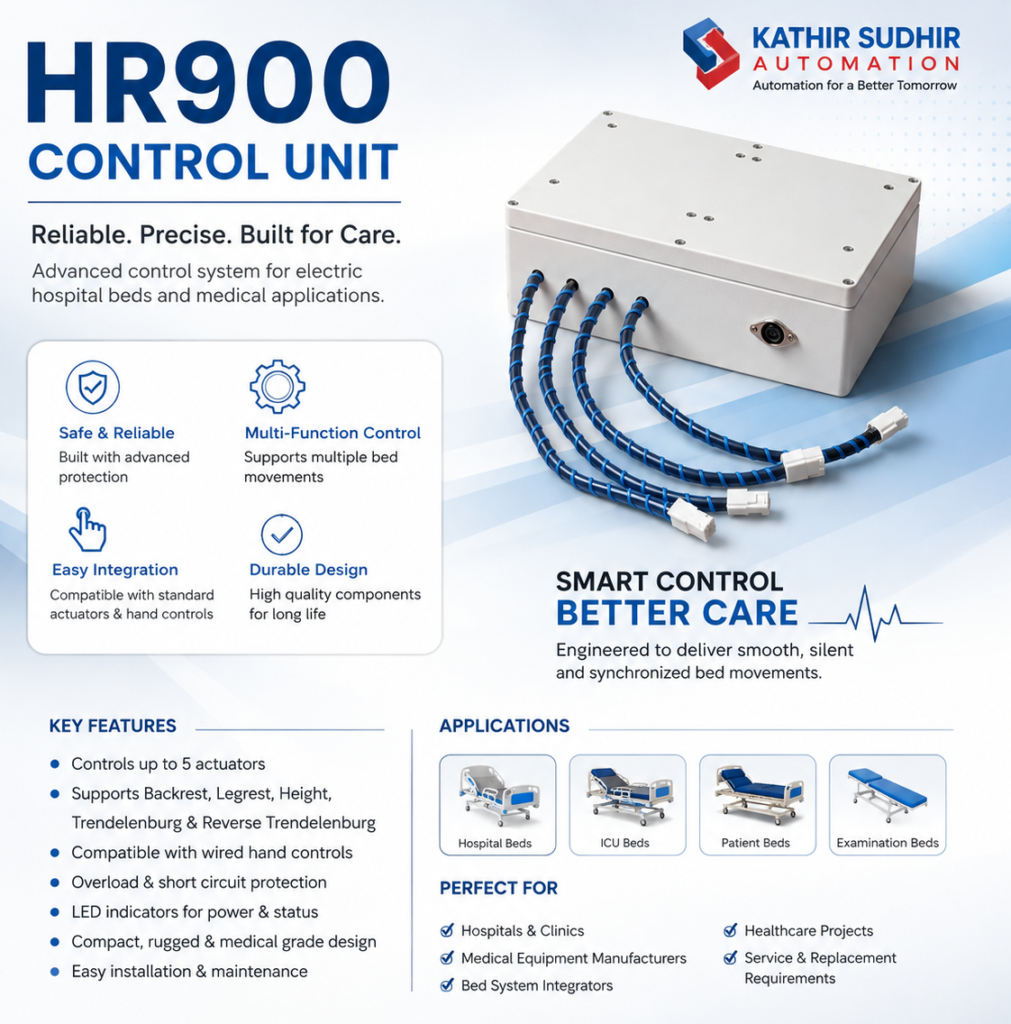
A hospital bed motor controller manages the electric motors or linear actuators used to adjust different sections of a medical bed. It allows healthcare staff and patients to control functions such as backrest adjustment, leg section movement, and overall bed height.
Modern electric hospital beds use multiple motors with a dedicated control unit or PCB. The controller receives commands from a hand control, nurse control panel, or foot control and operates the connected actuators.
What Is a Hospital Bed Motor Controller?
A hospital bed motor controller is an electronic control system designed to operate the motors or linear actuators installed in an electric hospital bed.
The controller manages the direction, movement, and operation of each motor. Depending on the bed configuration, one controller can operate multiple actuators independently.
Typical functions include:
- Backrest adjustment
- Leg rest adjustment
- Bed height adjustment
- Trendelenburg positioning
- Reverse Trendelenburg positioning
- Knee section adjustment
- Other motorized bed positioning functions
The controller helps provide smooth and controlled movement for different patient positions.
How Does a Hospital Bed Motor Controller Work?
The system normally consists of a control unit, hand controller, linear actuators, power supply, and connecting cables.
The basic operation is:
- The user presses a button on the hand controller.
- The control signal reaches the main control PCB.
- The PCB identifies the selected movement.
- The controller supplies power to the required motor or linear actuator.
- The actuator extends or retracts.
- The selected section of the hospital bed moves.
- Releasing the button stops the movement.
This system allows multiple bed functions to operate from a single control interface.
Backrest Adjustment
Backrest adjustment is one of the main functions of an electric hospital bed.
A linear actuator is installed between the bed frame and the backrest mechanism. When the controller receives a backrest command, it drives the actuator in the required direction.
The actuator movement changes the angle of the backrest.
Backrest adjustment helps position the patient for:
- Sitting
- Eating
- Reading
- Examination
- Medical procedures
- Patient transfer
The controller provides controlled movement instead of requiring manual adjustment.
Height Adjustment
Hospital bed height adjustment uses another motor or linear actuator connected to the bed lifting mechanism.
The motor controller activates the actuator when the user selects the height adjustment function. The bed moves upward or downward according to the control command.
Height adjustment helps healthcare staff set a suitable working height for:
- Patient care
- Bed transfers
- Examination
- Cleaning
- Patient positioning
Lowering the bed also helps provide easier access for patients getting into or out of bed.
Role of the PCB in a Hospital Bed Controller
The PCB is the main electronic control section of the system. It receives input signals and controls the connected motors or actuators.
A hospital bed controller PCB typically handles:
- Motor direction control
- Motor switching
- Input signal processing
- Multiple actuator control
- Power distribution
- Control interface connections
- Limit and protection functions
For a custom hospital bed controller, the PCB design should match the actuator specifications, power requirements, control inputs, and mechanical configuration of the bed.
Multiple Actuator Control
A hospital bed often requires several actuators. For example:
| Bed Function | Motor/Actuator |
|---|---|
| Backrest adjustment | Linear actuator |
| Leg section adjustment | Linear actuator |
| Bed height adjustment | Linear actuator |
| Trendelenburg | Linear actuator |
| Knee adjustment | Linear actuator |
The motor controller coordinates these functions through separate output channels.
A multi-function controller therefore reduces the need for separate motor control circuits for each bed movement.
Safety Features
Safety is an important consideration when designing a hospital bed motor controller.
Depending on the design, the controller should include suitable protection and control features such as:
- Over current protection
- Short-circuit protection
- Motor overload protection
- Limit switch support
- Controlled motor stopping
- Proper connector design
- Emergency stop functionality where required
- Suitable electrical isolation
- Protection against incorrect connections
The exact safety requirements depend on the bed design, actuator specifications, applicable medical-device standards, and intended use.
Why Use Linear Actuators?
Linear actuators provide controlled linear movement for hospital bed mechanisms. They convert motor rotation into push or pull movement.
Compared with manual adjustment mechanisms, electric linear actuators provide:
- Push-button operation
- Controlled positioning
- Compact installation
- Repeatable movement
- Multiple adjustment functions
- Integration with electronic control systems
The actuator must be selected according to the required load, stroke length, speed, duty cycle, mounting dimensions, and operating voltage.
Custom Hospital Bed Motor Controller
A custom motor controller PCB is useful when an existing control unit needs replacement, modification, or integration with a specific hospital bed design.
The development process typically includes:
- Studying the existing bed mechanism
- Identifying each motor and actuator
- Checking voltage and current requirements
- Understanding the existing control signals
- Analyzing the machine operation
- Designing the control circuit
- Developing the PCB
- Testing each motor channel
- Testing the complete bed system
Machine analysis is especially important because the PCB must match the actual actuator movement and control requirements.
Applications
Hospital bed motor controllers are used in:
- Electric hospital beds
- ICU beds
- Patient beds
- Examination beds
- Medical treatment beds
- Nursing care beds
- Long-term care beds
- Adjustable medical furniture
Conclusion
A hospital bed motor controller provides centralized control of the electric motors and linear actuators used for backrest, height, leg, and other positioning functions. A properly designed PCB helps coordinate multiple actuators while providing reliable control and appropriate protection.
For companies developing or replacing hospital bed electronics, understanding the existing machine, actuator specifications, control inputs, and PCB architecture is an important part of developing a suitable motor controller.
0 responses to “Hospital Bed Motor Controller for Backrest and Height Adjustment”