
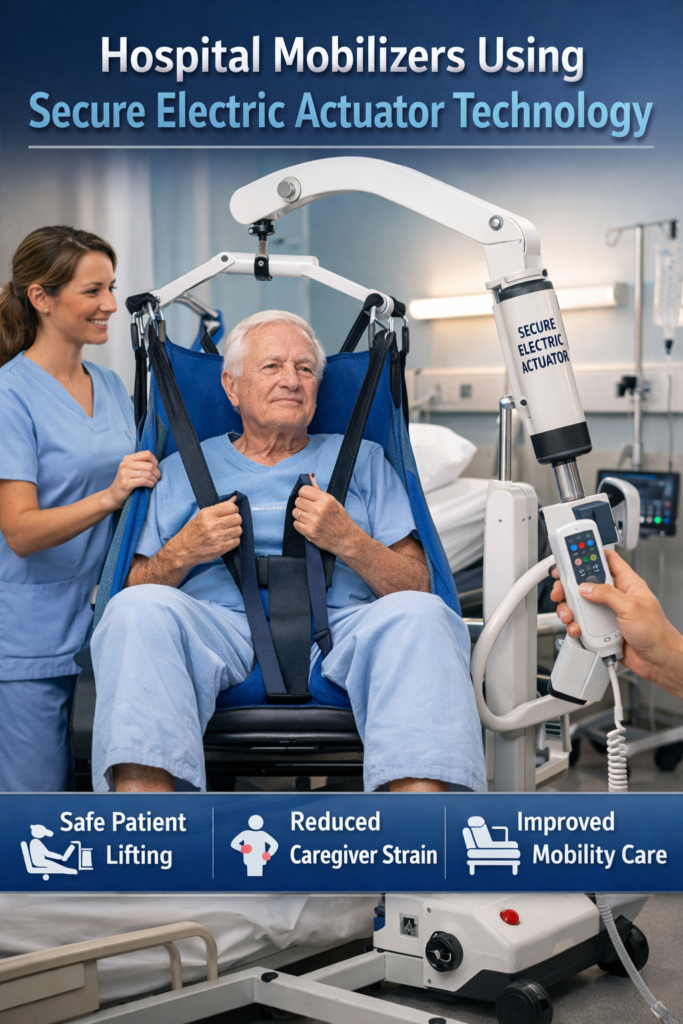
In modern hospitals, patient mobilizers powered by electric actuator have transformed the way caregivers lift and transfer patients. These systems ensure smooth, controlled movement while reducing physical strain on nurses and attendants. From adjustable beds to patient hoists, electric linear actuators make mobility safer, faster, and more comfortable for both patients and healthcare staff.
Why Electric Actuation for the Healthcare Industry?
Healthcare demands precision, safety, hygiene, and reliability. Electric actuation systems offer:
- Smooth and jerk-free lifting
- Low noise operation for ICU and ward environments
- Battery backup for uninterrupted use
- Reduced caregiver injury risk
- High load handling capacity (often up to 250 lbs or more)
Unlike manual hydraulic systems, electric actuators provide push-button control, enabling even a single caregiver to move a patient safely.
How It Is Used in Hospitals
Mobilizers using electric actuators—such as patient lifts, hoists, and powered transfer chairs—use low-noise linear actuators like FY013 Linear Actuator to safely lift and transport patients with reduced mobility.
Key Usage Areas:
- Patient Lifts & Hoists – Safe transfer from bed to wheelchair
- Adjustable Hospital Beds – Control height, tilt, backrest
- Rehabilitation Equipment – Smooth exercise positioning
- Powered Wheelchairs – Height, tilt & recline adjustment
Most systems integrate with a Kathir Sudhir Control Unit featuring battery-powered operation for portability and emergency safety.
Required Components
- Linear Actuator (e.g., FY013 Model)
- Control Box
- Hand Remote / Wired Controller
- Battery Backup System
- Mounting Brackets
- Frame Structure (lift/bed/hoist body)
- Safety Lock / Manual Release
Key Features and Technology
- Low-noise motor mechanism
- High load-bearing capacity
- IP-rated water-resistant design
- Anti-pinch safety system
- Manual emergency lowering
- Intelligent control integration
- Smooth start & stop function
How to Control a Electric Actuator
- Connect actuator to control box.
- Ensure battery is charged.
- Use handheld remote to extend (lift) or retract (lower).
- Monitor movement speed and stop at required height.
- Use manual override during power failure.
Advanced systems allow programmable position memory.
Steps to Follow While Using Hospital Mobilizer
- Assess patient condition.
- Lock wheels of bed and lift.
- Attach sling correctly under patient.
- Confirm weight capacity.
- Operate actuator gradually.
- Monitor patient comfort during transfer.
- Lower gently into wheelchair or bed.
- Remove sling carefully.
Checklist for You (Before Every Transfer)
✔ Battery fully charged
✔ Sling straps secured
✔ Actuator functioning smoothly
✔ Patient weight within limit
✔ Emergency release tested
✔ Wheels locked
Key Application Areas
- ICU & Critical Care Units
- Orthopedic Recovery Wards
- Elderly Care Homes
- Rehabilitation Centers
- Home Healthcare
Comparison Table
| Feature | Electric Actuator Mobilizer | Manual Hydraulic Lift |
|---|---|---|
| Effort Required | Minimal | High |
| Movement Smoothness | Very Smooth | Moderate |
| Noise Level | Low | Moderate |
| Caregiver Safety | High | Medium |
| Power Source | Battery/Electric | Manual Pump |
| Precision Control | Excellent | Limited |
Advantages and Disadvantages
Advantages
- Reduces caregiver musculoskeletal injuries
- Improves patient dignity & independence
- Easy to operate
- Precise and repeatable positioning
- Energy-efficient
Disadvantages
- Higher initial cost
- Requires battery maintenance
- Electrical component servicing needed
Key Aspects to Consider
- Load capacity
- Stroke length
- Speed
- IP rating
- Noise level
- Battery backup time
- Warranty and service support
Examples of Use
- Transferring post-surgery patient from bed to wheelchair
- Lifting paralyzed patient for hygiene care
- Adjusting ICU bed tilt during respiratory therapy
- Positioning patient in rehabilitation equipment
Why Should You Partner with Kathir Sudhir Automation?
At Kathir Sudhir Automation India Pvt Ltd, we specialize in reliable electric actuation systems for healthcare and industrial applications.
We offer:
- Custom actuator integration
- High-load medical-grade solutions
- Durable control systems
- Technical support & after-sales service
- Affordable pricing with premium performance
Our goal is to make hospital mobility safer, smarter, and more efficient.
(FAQs)
1. Regarding the movement of patients which of the following is unnecessary?
Unnecessary actions include sudden jerky movements or lifting without assessing patient condition and equipment readiness.
2. What is the most appropriate method to use when moving a patient?
Using a mechanical lift or electric actuator-based mobilizer is the safest and most appropriate method.
3. Move patient without moving spine?
Use a log-roll technique or a spinal board with full support, ensuring the spine remains aligned.
4. When lifting a patient what must you remember?
Maintain proper posture, bend your knees, keep back straight, and use assistive devices whenever possible.
5. While teaching a continuing education class on lifting and moving patients, which points would you constantly emphasize?
Safety, body mechanics, use of mechanical aids, communication, and patient dignity.
6. Which of the following should be considered when moving and handling a patient?
Patient weight, medical condition, equipment availability, environment safety, and caregiver strength.
7. How to lift a paralyzed person from the floor?
Use a patient lift with sling support and operate slowly with proper stabilization.
8. How to lift disabled person?
Use assistive devices like electric hoists or sliding boards to avoid caregiver strain.
9. How to move a bedridden patient?
Use adjustable beds with electric actuators or reposition using draw sheets and mechanical lifts.
10. What are safe methods for lifting patients?
Mechanical lifts, electric actuator-based hoists, slide sheets, team lifting, and proper ergonomic techniques.