
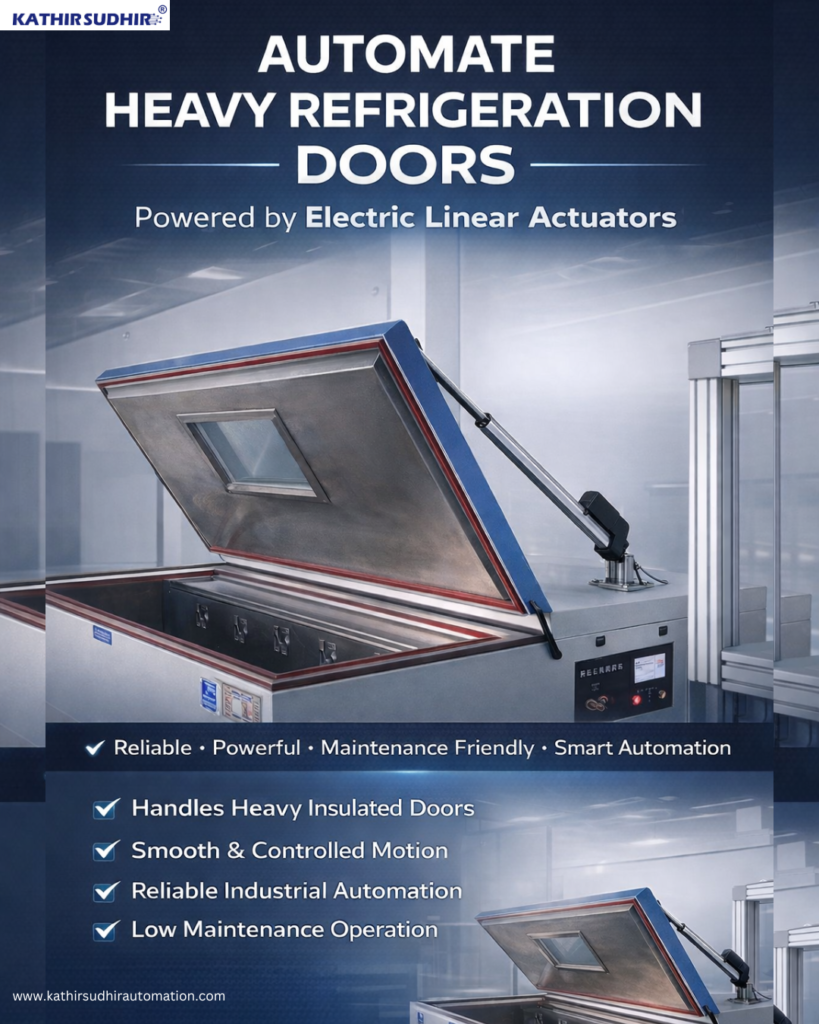
In cold storage facilities and industrial refrigeration units, doors are often large, insulated, and extremely heavy. Manually opening and closing these doors can be inconvenient, inefficient, and sometimes unsafe. Using linear actuator to automate refrigeration doors provides a reliable and hands-free solution that improves operational efficiency, sealing performance, and energy savings. These automated systems deliver controlled motion, ensuring smooth opening and tight sealing for optimal temperature maintenance.
What is a Linear Actuator Used For?
A linear actuator is an electromechanical device that converts rotational motion from a motor into straight-line movement. This movement can push, pull, lift, or position heavy objects with high precision.
Common Uses
- Opening and closing industrial doors
- Adjusting solar panels and trackers
- Controlling valves and dampers
- Medical equipment positioning
- Automated furniture and lifts
- Industrial automation systems
In refrigeration door automation, the actuator applies controlled pushing or pulling force to move heavy insulated doors smoothly.
How Linear Actuator Work in Refrigeration Door Systems
In an automated refrigeration door setup:
- The actuator is mounted between the door frame and door panel.
- When power is supplied, the actuator extends or retracts.
- Extension pushes the door open.
- Retraction pulls the door closed tightly against the gasket.
- Sensors and limit switches control movement and safety.
Key Operating Principle
System Components
1. High-Force Linear Actuator
These provide the main mechanical force required to move heavy refrigeration doors.
Recommended force capacity:
- 6000N actuator (≈ 611 kg force)
- 8000N actuator (≈ 800 kg force)
2. Control Unit & Sensors
A microcontroller or PLC manages the door movement.
Common sensors include:
- PIR sensors for motion detection
- Ultrasonic sensors for vehicle detection
- Position sensors to track actuator movement
3. Limit Switches
Limit switches stop the actuator when the door reaches:
- Fully open position
- Fully closed position
This prevents motor overload and mechanical damage.
4. Safety Mechanisms
Safety sensors reverse the actuator if an obstruction is detected.
Key Features and Technology
Modern actuator-based refrigeration door systems include:
- Intelligent motion controllers
- Obstruction detection systems
- Synchronization for dual actuators
- Remote control or automation integration
- Adjustable opening speeds
- Overload protection
Required Components
A complete refrigeration door automation system includes:
- High-force linear actuator
- Power supply
- Control unit or PLC
- Mounting brackets
- Limit switches
- Safety sensors
- Remote or manual control switch
How to Control a Linear Actuator
Linear actuators can be controlled in several ways:
Basic Control
- Toggle switch
- Rocker switch
Advanced Control
- Remote control system
- PLC automation
- Microcontroller-based system
- Smart IoT integration
Control Methods
| Control Method | Description |
|---|---|
| Manual Switch | Simple push-button or rocker switch |
| Remote Control | Wireless door operation |
| PLC Automation | Industrial automation integration |
| Sensor Triggered | Automatic opening when someone approaches |
How to Calculate Linear Actuator Position
Actuator position is determined by measuring the extension of the actuator rod.
Simple Calculation
Position = Stroke Length × Percentage Extension
Example:
- Stroke Length = 500 mm
- Extension = 60%
Position = 300 mm
Position Feedback Methods
- Hall sensors
- Potentiometer feedback
- Optical encoders
These systems provide precise actuator positioning and synchronization.
Key Aspects of Refrigeration Door Automation
Important considerations include:
- Door weight and size
- Gasket resistance and seal pressure
- Actuator force capacity
- Mounting geometry and leverage
- Environmental protection (IP rating)
Key Implementation Considerations
Dual Actuator Setup
For large doors, two synchronized actuators are installed.
Benefits:
- Prevents door twisting
- Provides balanced force
- Allows use of smaller actuators
Mounting and Leverage
Proper actuator mounting angle helps overcome initial seal resistance.
Gasket Resistance
Cold storage doors have strong magnetic or suction seals.
The actuator must provide enough force to break this seal during initial opening.
Key Application Areas & Reasons
Linear actuator door systems are used in:
- Cold storage warehouses
- Food processing plants
- Pharmaceutical storage rooms
- Industrial refrigeration units
- Logistics distribution centers
Reasons for Automation
- Reduce manual effort
- Improve sealing performance
- Increase operational efficiency
- Maintain cold chain integrity
Operations & Functions
The automated system performs several functions:
- Automatic door opening
- Controlled closing motion
- Safety stop and reverse
- Position monitoring
- Energy-efficient sealing
Key Benefits & Specifications
Benefits
- Hands-free operation
- Improved energy efficiency
- Precise door control
- Reduced labor effort
- Enhanced safety
Typical Specifications
| Parameter | Value |
|---|---|
| Force Capacity | 6000N – 8000N |
| Stroke Length | 100 mm – 1000 mm |
| Voltage | 12V / 24V DC |
| Speed | 5–40 mm/s |
| Protection Rating | IP54 – IP66 |
Advantages and Disadvantages
Advantages
- High load capacity
- Precise motion control
- Easy automation integration
- Reliable and durable
- Low maintenance
Disadvantages
- Higher initial installation cost
- Requires proper mounting design
- Power supply dependency
Comparison Table
| Feature | Manual Door | Linear Actuator Door |
|---|---|---|
| Operation | Manual effort | Automatic |
| Efficiency | Low | High |
| Safety | Moderate | High |
| Energy Loss | Higher | Lower |
| Maintenance | Low | Moderate |
Steps to Follow for Implementation
- Measure door weight and dimensions
- Calculate required actuator force
- Select suitable stroke length
- Install mounting brackets
- Connect actuator to controller
- Configure limit switches
- Install safety sensors
- Test operation and calibration
Checklist for Installation
Before installing the system, check:
- Door weight capacity
- Actuator force rating
- Mounting position
- Power supply availability
- Controller compatibility
- Safety sensor installation
Examples of Use
Example 1
A cold storage warehouse uses two 8000N actuators to open a 3-meter insulated door.
Example 2
A food processing plant installs automatic sliding freezer doors controlled by motion sensors.
Example 3
A pharmaceutical storage room uses remote-controlled actuator doors to maintain sterile conditions.
How Much is a New Linear Actuator?
The price of a new actuator depends on:
- Force rating
- Stroke length
- IP protection
- Feedback system
Industrial refrigeration door actuators are usually high-force models designed for continuous duty operation
FAQs
1. What is a linear actuator used for?
A linear actuator converts rotational motion into straight movement and is used to automate doors, machines, valves, lifts, and industrial equipment.
2. Can a linear actuator open heavy doors?
Yes. High-force actuators with 6000N to 8000N capacity can easily open heavy insulated refrigeration doors.
3. How do you control a linear actuator?
Actuators can be controlled using switches, PLC controllers, remote systems, or automatic sensors.
4. What power supply is required?
Most industrial linear actuators operate on 12V DC or 24V DC power supplies.
5. Are linear actuator safe for automated doors?
Yes. Safety sensors and limit switches prevent accidents and motor overload.
6. How long does a linear actuator last?
A good quality actuator can last 5 to 10 years depending on usage and maintenance.
7. Can linear actuator work in cold storage environments?
Yes. Industrial actuators are designed with IP-rated protection and temperature resistance.
8. What stroke length is required for door automation?
The stroke length depends on the door size and mounting geometry, typically between 200 mm and 800 mm.
9. Why use two linear actuator for large doors?
Dual actuators prevent door twisting and provide balanced force for smoother movement.
10. Do automated refrigeration doors save energy?
Yes. Automated doors close tightly and quickly, reducing cold air loss and improving energy efficiency.
Conclusion
Automating heavy refrigeration doors using linear actuators is an efficient solution for modern industrial facilities. These systems provide controlled movement, strong sealing performance, and improved safety, making them ideal for cold storage and refrigerated environments. With proper actuator selection, intelligent control systems, and safety sensors, businesses can significantly enhance operational efficiency while maintaining optimal temperature conditions in refrigeration systems.
0 responses to “Refrigeration Door System with the Powerful Linear Actuator”