
Have you ever wondered how modern buildings automatically open windows and skylights for fresh air without manual effort? The answer lies in electric linear actuators, which provide smooth, precise, and reliable control of tilting mechanisms for windows and skylights.
By automating ventilation and natural lighting, linear actuators help improve indoor comfort, energy efficiency, and building safety. In this guide, we’ll explore how these systems work, where they are used, and why they are becoming an essential part of smart buildings.
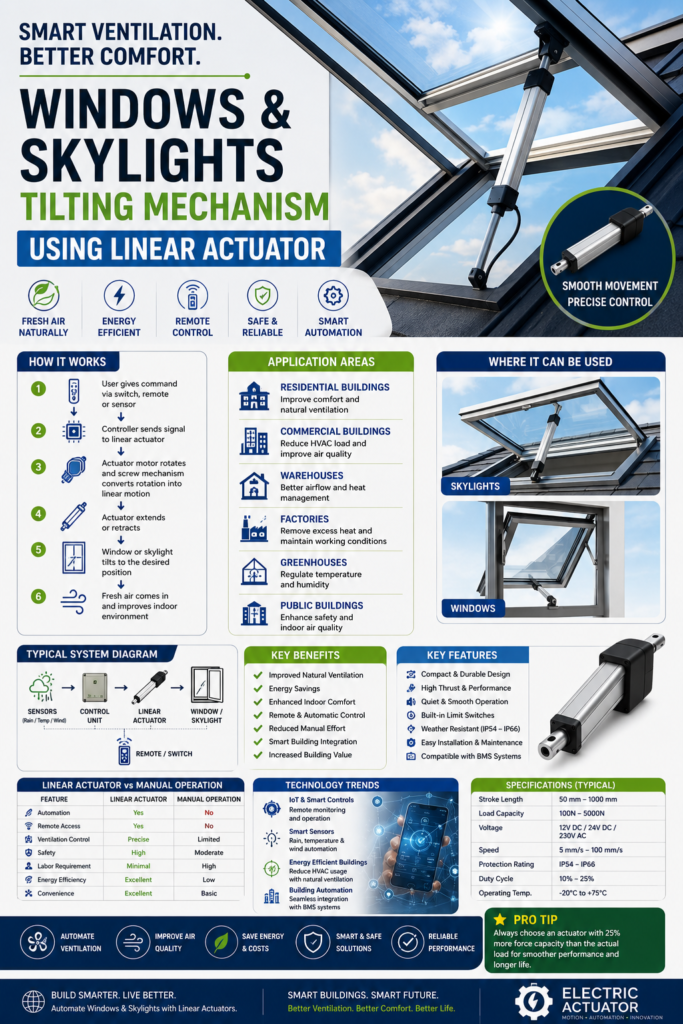
Overview of Windows and Skylights Tilting Mechanisms
A linear actuator converts electrical energy into controlled linear motion. When installed on a window or skylight, the actuator extends or retracts to tilt, open, or close the structure automatically.
Key Aspects
- Automated ventilation control
- Improved natural airflow
- Enhanced indoor comfort
- Energy-efficient building operation
- Remote and smart control capability
- Reduced manual intervention
Visual 1: Linear Actuator Installed on a Skylight
(Insert image showing a linear actuator opening a roof skylight in a commercial building.)
How Linear Actuators Work in Windows and Skylights
Step-by-Step Operation
- User presses a switch or remote control.
- Controller sends a signal to the actuator.
- Actuator motor rotates internally.
- Screw mechanism converts rotation into linear motion.
- Actuator extends or retracts.
- Window or skylight tilts to the desired angle.
- Position is maintained until a new command is received.
Example
In a warehouse, a skylight opens automatically when indoor temperatures rise above a preset level. Fresh air enters, reducing heat buildup and improving ventilation.
Required Components
| Component | Function |
|---|---|
| Electric Linear Actuator | Creates opening and closing motion |
| Power Supply | Provides electrical power |
| Control Switch | Manual operation |
| Remote Controller | Wireless operation |
| Control Unit | Automated control |
| Mounting Brackets | Secure installation |
| Sensors (Optional) | Rain, temperature, or wind detection |
Operations and Functions
Main Functions
- Open windows
- Close windows
- Tilt skylights
- Control ventilation
- Improve airflow
- Enable remote operation
- Automate environmental control
Advanced Functions
- Rain-sensitive closing
- Temperature-based opening
- Smart building integration
- Emergency smoke ventilation
Key Application Areas and Reasons
Residential Buildings
Reason: Improve comfort and natural ventilation.
Commercial Buildings
Reason: Reduce HVAC dependency and energy consumption.
Warehouses
Reason: Improve airflow and heat management.
Factories
Reason: Remove excess heat and maintain working conditions.
Greenhouses
Reason: Regulate temperature and humidity.
Public Buildings
Reason: Enhance indoor air quality and safety.
Comparison Table: Linear Actuator vs Manual Window Operation
| Feature | Linear Actuator | Manual Operation |
| Automation | Yes | No |
| Remote Access | Yes | No |
| Safety | High | Moderate |
| Ventilation Control | Precise | Limited |
| Labor Requirement | Minimal | High |
| Smart Integration | Available | Not Available |
| Convenience | Excellent | Basic |
Visual 2: Automated Window Ventilation System
(Insert diagram showing actuator-controlled windows connected to sensors and controllers.)
Key Benefits and Specifications
Benefits
- Improved indoor air quality
- Better natural ventilation
- Increased energy efficiency
- Enhanced comfort
- Reduced cooling costs
- Smart automation compatibility
- Improved building safety
Typical Specifications
| Parameter | Range |
| Stroke Length | 50 mm – 1000 mm |
| Voltage | 12V, 24V, 230V |
| Load Capacity | 100N – 5000N |
| Speed | 5 mm/s – 100 mm/s |
| Protection Rating | IP54 – IP66 |
| Control Type | Switch, Remote, PLC |
Key Features
- Compact design
- Quiet operation
- Built-in limit switches
- Position feedback options
- Maintenance-free operation
- Weather-resistant construction
- Smart automation compatibility
Technology Trends
IoT Integration
Windows and skylights can be monitored and controlled remotely through mobile apps.
Smart Sensors
Temperature, rain, and wind sensors automate operation.
Building Automation Systems
Actuators are increasingly integrated with BMS platforms.
Energy-Efficient Buildings
Automated natural ventilation helps reduce HVAC energy consumption.
Advantages and Disadvantages
Advantages
✔ Precise positioning
✔ Remote operation
✔ Improved ventilation
✔ Energy savings
✔ Better user convenience
✔ Reduced maintenance
Disadvantages
✖ Initial installation cost
✖ Requires power supply
✖ Professional setup may be required
✖ Sensor dependency for automation
Steps to Follow for Installation
Step 1
Measure window or skylight dimensions.
Step 2
Determine required opening angle.
Step 3
Select suitable actuator force and stroke.
Step 4
Install mounting brackets.
Step 5
Connect actuator and control system.
Step 6
Test opening and closing functions.
Step 7
Configure sensors if applicable.
Step 8
Perform final safety inspection.
Installation Checklist
Before Installation
- Verify actuator specifications
- Check load requirements
- Confirm mounting space
- Ensure power availability
During Installation
- Secure brackets properly
- Verify alignment
- Test actuator movement
- Inspect wiring
After Installation
- Verify opening angle
- Test emergency operation
- Check sensor integration
- Schedule maintenance inspections
Key Prevention Techniques
To ensure long-term reliability:
- Avoid actuator overloading
- Regularly inspect mounting hardware
- Keep moving parts clean
- Protect electrical connections
- Test safety systems periodically
- Follow manufacturer recommendations
Compliance and Best Practices
Best Practices
- Use weather-resistant actuators outdoors
- Install emergency manual override
- Follow local building regulations
- Use certified electrical components
- Perform regular inspections
Compliance Considerations
- Building safety standards
- Electrical installation regulations
- Fire and smoke ventilation requirements
- Energy efficiency guidelines
Pro Tip
For skylight applications, always choose an actuator with at least 25% more force capacity than the calculated load. This provides smoother operation and increases system longevity.
Real-World Example
A commercial office building replaced manual skylights with actuator-operated units integrated with temperature sensors.
Results
- Improved natural ventilation
- Reduced HVAC energy usage
- Better employee comfort
- Automated climate control
- Lower maintenance requirements
Related Resources
Explore more actuator applications:
- https://electricactuator.in/
- https://electricactuator.in/
- https://electricactuator.in/
- https://electricactuator.in/
- https://electricactuator.in/
Conclusion
Linear actuators have transformed how windows and skylights operate in modern buildings. By enabling automated opening, closing, and tilting functions, they improve ventilation, comfort, energy efficiency, and safety. Whether used in homes, commercial buildings, warehouses, or greenhouses, actuator-based window automation provides a reliable and future-ready solution for smarter building management.
People Also Ask (FAQ)
1. What is a linear actuator used for in windows and skylights?
A linear actuator automates the opening, closing, and tilting of windows and skylights for ventilation and comfort.
2. Can linear actuators be used outdoors?
Yes, weather-resistant actuators with suitable IP ratings are designed for outdoor applications.
3. How are skylights automated?
Skylights are automated using electric actuators connected to switches, remotes, or building automation systems.
4. Can windows be controlled remotely?
Yes, many actuator systems support remote controls, mobile apps, and smart home integration.
5. What force is required for a skylight actuator?
The required force depends on skylight size, weight, and opening angle.
6. Are actuator-operated windows energy efficient?
Yes, they improve natural ventilation and can reduce HVAC energy consumption.
7. Can actuators work with rain sensors?
Yes, rain sensors can automatically close windows and skylights during bad weather.
8. How long do linear actuators last?
High-quality actuators can operate reliably for many years with proper maintenance.
9. Are linear actuators safe for building applications?
Yes, when properly installed and maintained, they provide safe and reliable operation.
10. Which industries commonly use automated skylights?
Commercial buildings, warehouses, factories, greenhouses, and public facilities commonly use automated skylight systems.
0 responses to “Windows and Skylights Tilting Mechanism Using Linear Actuators”