
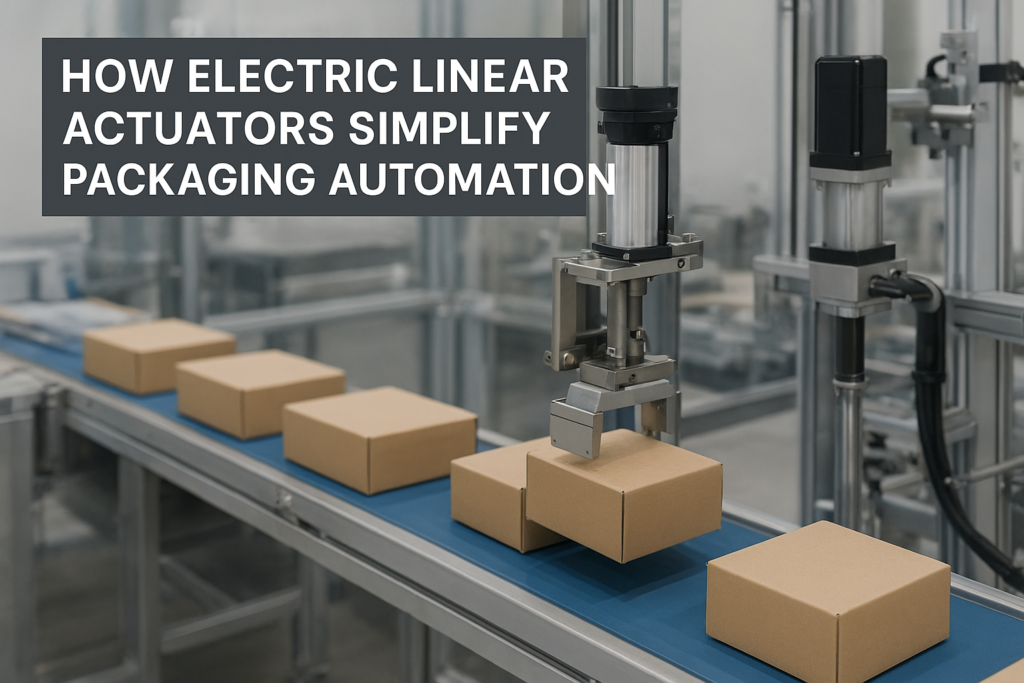
In today’s fast-moving consumer world, packaging plays a critical role in efficiency, quality, and product safety. To meet high production demands, industries are moving away from traditional pneumatic and hydraulic systems and adopting electric linear actuators. These actuators are transforming packaging automation by offering precision, flexibility, and energy efficiency.
Why Electric Linear Actuators in Packaging?
Packaging lines demand consistent, accurate, and repeatable motion. Whether it’s pushing, lifting, cutting, sealing, or sorting, every movement must be precise to ensure product quality. Electric actuators provide this level of accuracy, unlike air-driven or oil-based systems that often suffer from leakage, noise, and maintenance issues.
Key Benefits of Electric Linear Actuators in Packaging Automation:
- Precision & Repeatability
Electric actuators deliver accurate motion with programmable stroke lengths, ensuring consistent packaging quality every time. - Energy Efficiency
Unlike pneumatics, electric actuators consume power only during motion, making them more sustainable and cost-efficient. - Clean Operation
Since no oil or compressed air is involved, actuators are ideal for food, pharma, and cleanroom packaging applications. - Flexibility
Packaging lines often deal with multiple product sizes. With easy reprogramming, actuators allow quick adjustments without complex mechanical changes. - Low Maintenance
Electric actuators have fewer moving parts, reducing downtime and operational costs compared to traditional systems.
Applications in Packaging Automation
Electric linear actuators are already being used in:
- Carton forming and sealing machines
- Labeling and marking equipment
- Pick-and-place systems
- Pouch filling and sealing machines
- Sorting and diverting conveyors
By integrating actuators, manufacturers achieve faster cycle times, greater reliability, and higher productivity.
Future of Packaging with Electric Actuators
As smart factories evolve, electric actuators will play a central role in packaging automation. Their ability to connect with IoT and Industry 4.0 systems means data-driven insights, predictive maintenance, and fully automated production lines.
Conclusion
Electric linear actuators simplify packaging automation by offering clean, precise, and flexible motion control. For industries looking to boost efficiency, reduce energy use, and ensure reliable packaging performance, switching to electric actuators is the smarter choice.
FAQ
1. What is an electric linear actuator in packaging automation?
An electric linear actuator is a motor-driven device that converts electrical energy into linear motion. In packaging automation, it is used for tasks such as pushing, lifting, sealing, cutting, labeling, and sorting products with high precision and repeatability.
2. Why are electric actuators better than pneumatic systems in packaging lines?
Electric actuators provide higher accuracy, programmable stroke control, energy efficiency, and cleaner operation. Unlike pneumatic systems, they do not require compressed air, which reduces energy waste, noise, and maintenance costs.
3. How do electric linear actuators improve packaging quality?
They ensure consistent and repeatable motion, which helps maintain uniform sealing, cutting, filling, and positioning. This reduces product damage, sealing errors, and packaging defects.
4. Are electric actuators suitable for food and pharmaceutical packaging?
Yes. Electric actuators operate without oil leakage or compressed air contamination, making them ideal for hygienic environments such as food processing, pharmaceutical manufacturing, and cleanroom packaging.
5. Do electric linear actuators reduce energy consumption?
Yes. Electric actuators consume power only during motion, unlike pneumatic systems that continuously run compressors. This significantly lowers energy costs and improves overall efficiency.
6. Can electric actuators handle different product sizes in packaging lines?
Absolutely. Electric actuators can be easily reprogrammed to adjust stroke length, speed, and force. This allows manufacturers to switch between different product sizes without complex mechanical modifications.
7. What are common applications of electric actuators in packaging machines?
Electric linear actuators are widely used in:
- Carton forming and sealing machines
- Pouch filling and sealing systems
- Pick-and-place units
- Labeling and marking equipment
- Sorting and diverting conveyors
8. How do electric actuators support Industry 4.0 in packaging?
Electric actuators can integrate with smart factory systems, enabling real-time monitoring, predictive maintenance, and data-driven performance optimization. This supports fully automated and connected production lines.
9. Are electric linear actuators low maintenance compared to hydraulic systems?
Yes. Electric actuators have fewer mechanical components and do not require hydraulic fluid. This reduces maintenance frequency, downtime, and operational costs.
10. What should manufacturers consider when choosing an electric actuator for packaging?
Manufacturers should evaluate load capacity, stroke length, speed requirements, duty cycle, environmental conditions, and compatibility with existing automation systems to ensure optimal performance.
0 responses to “How Electric Linear Actuators Simplify the Reliable Packaging Automation”