
In industries such as mining, construction, cement, and bulk material handling, dust control is a major challenge. Excessive dust not only impacts air quality and worker health but also reduces equipment efficiency and increases maintenance costs. To address this, dust suppression systems are widely used, and integrating electric actuators into these systems brings a new level of automation, precision, and reliability.
Why Electric Actuators?
Traditional dust suppression systems often rely on manual operation, pneumatic, or hydraulic controls. However, electric actuators offer several advantages that make them the preferred choice for modern industries:
- Energy Efficient – Operates only when required, with low power consumption.
- Low Maintenance – No leaks or complex fluid systems as in hydraulics or pneumatics.
- Precision Control – Accurate positioning ensures optimal dust suppression with minimal water wastage.
- Environment-Friendly – Runs on clean electric power, reducing carbon footprint.
Applications of Electric Actuators in Dust Suppression
- Nozzle Positioning – Actuators adjust spray nozzles automatically to target dust-intensive areas, ensuring efficient coverage.
- Valve Operation – Electric actuators regulate water flow precisely, maintaining consistent pressure and volume.
- Mobile Equipment Integration – Mounted on conveyors, crushers, or trucks for on-demand dust control.
- Remote & Automated Control – Integration with sensors and PLCs enables automatic activation when dust levels exceed thresholds.
Benefits for Industries
- Improved Workplace Safety – Reduces airborne dust, protecting workers from respiratory hazards.
- Optimized Water Usage – Prevents over-spraying, ensuring cost-effective operation.
- Reduced Downtime – Automation minimizes manual intervention, keeping systems operational longer.
- Scalable Solutions – Easily adaptable for small plants to large industrial operations.
Real-World Example
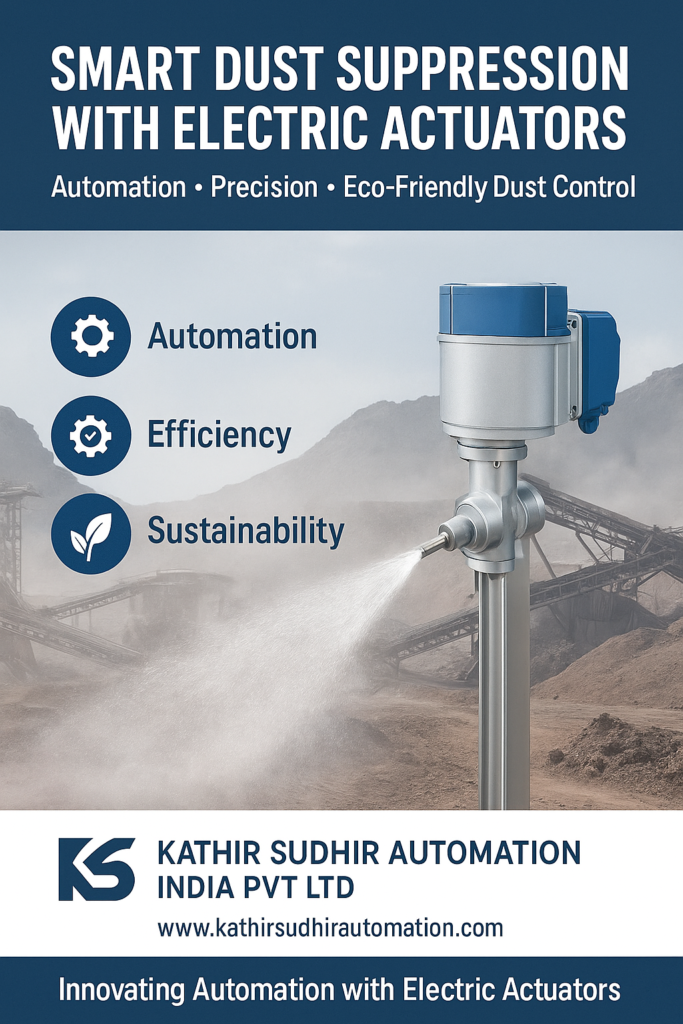
Imagine a mining conveyor system where electric actuators adjust water spray nozzles automatically based on dust sensor feedback. This ensures dust is suppressed effectively only when required, avoiding water wastage and improving efficiency.
Conclusion
Electric actuators are revolutionizing dust suppression systems by bringing automation, efficiency, and sustainability into the process. As industries increasingly move toward eco-friendly and smart solutions, integrating electric actuators ensures both operational excellence and compliance with environmental regulations.
FAQ
1. What is a dust suppression system in industrial applications?
A dust suppression system is a technology used in industries such as mining, construction, cement, and bulk material handling to control airborne dust. It typically uses water sprays, misting systems, or chemicals to reduce dust particles in the air, improving workplace safety, protecting equipment, and maintaining air quality.
2. How do electric actuators improve dust suppression systems?
Electric actuators automate the positioning of spray nozzles and the operation of water control valves in dust suppression systems. This allows precise control of water flow and spray direction, improving dust control efficiency while minimizing water consumption and manual intervention.
3. Why are electric actuators better than pneumatic or hydraulic systems for dust control?
Electric actuators are often preferred because they are energy-efficient, require less maintenance, and eliminate the risk of fluid leaks associated with hydraulic or pneumatic systems. They also offer accurate positioning and easy integration with automation systems like PLCs and sensors.
4. What industries use electric actuators for dust suppression?
Electric actuators are widely used in industries where dust generation is common, including mining, cement manufacturing, construction, coal handling plants, steel plants, and bulk material handling facilities.
5. Can electric actuators be integrated with dust monitoring sensors?
Yes, electric actuators can be integrated with dust sensors, PLC systems, and automated control systems. When dust levels exceed predefined limits, the actuators can automatically adjust spray nozzles or activate valves to control dust effectively.
6. How do electric actuators help reduce water consumption in dust suppression systems?
Electric actuators provide precise control over valve opening and nozzle positioning. This ensures that water is sprayed only when and where it is needed, preventing over-spraying and significantly reducing water wastage.
7. Are electric actuators suitable for harsh industrial environments?
Yes, many industrial electric actuators are designed with rugged housings and high protection ratings (such as IP65 or IP67), making them suitable for dusty, wet, and harsh environments found in mining, cement plants, and construction sites.
8. What role do electric actuators play in automated dust control systems?
Electric actuators enable full automation in dust control systems by adjusting spray angles, controlling water valves, and responding to real-time data from sensors. This allows industries to maintain consistent dust suppression without manual operation.
9. How do electric actuators improve worker safety in dusty industries?
By automating dust suppression systems, electric actuators help reduce airborne dust levels in industrial environments. This lowers the risk of respiratory health issues for workers and improves overall workplace safety.
10. What are the benefits of using electric actuators in conveyor dust suppression systems?
In conveyor systems, electric actuators can automatically adjust spray nozzles based on dust intensity. This ensures efficient dust control, reduces water usage, prevents equipment contamination, and maintains smooth conveyor operation
0 responses to “Reliable Electric Actuator Integration in the Dust Suppression Systems”