
In today’s fast-paced industrial world, the demand for stable, reliable, and precise motion control is higher than ever. Whether it’s in robotics, automation, or medical devices, achieving smooth and accurate movement is key to performance. This is where Hall Effect sensors play a crucial role in empowering actuators to deliver outstanding results.
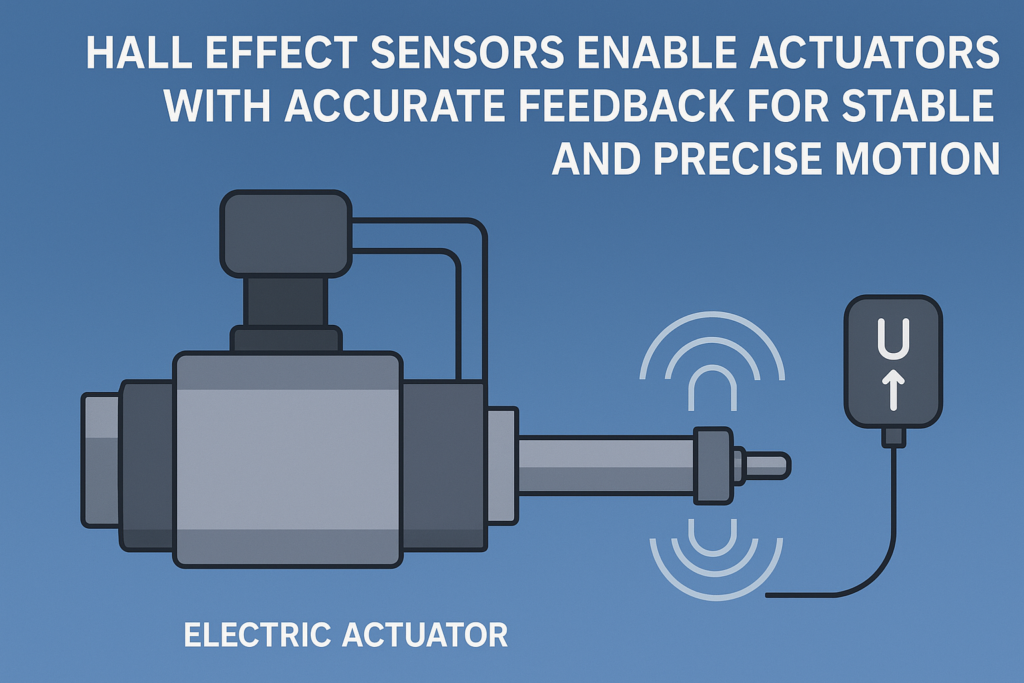
What is a Hall Effect Sensor?
A Hall Effect sensor is an electronic device that detects the presence and strength of a magnetic field. When integrated into an actuator, it provides real-time position and speed feedback without physical contact, making it highly durable and reliable even in challenging environments.
How Hall Effect Sensors Improve Actuator Performance
- Accurate Position Feedback – By detecting the rotation angle or linear movement, the sensor allows the actuator to know its exact position.
- Precise Motion Control – Feedback enables the actuator to adjust its movement instantly, reducing errors and overshooting.
- Smooth Operation – Stable feedback eliminates jerky movements, resulting in seamless motion in automation systems.
- Durability and Reliability – Since there’s no physical contact, wear and tear are minimized, making it ideal for long-term use.
- Compact Integration – Hall sensors are small and easily embedded into electric actuators without increasing design complexity.
Applications of Hall Effect Sensors in Actuators
- Robotics – Enables robotic arms to move with surgical precision.
- Medical Equipment – Ensures smooth and controlled positioning in patient beds and imaging devices.
- Industrial Automation – Provides reliable feedback for conveyors, pick-and-place systems, and assembly lines.
- Automotive – Improves performance in electric seats, throttle control, and advanced driver-assistance systems (ADAS).
Why It Matters
Without accurate feedback, actuators risk delivering unstable motion, which can compromise safety, efficiency, and productivity. By integrating Hall Effect sensors, industries can achieve:
- Higher efficiency
- Greater reliability
- Longer actuator lifespan
- Consistent performance under variable loads
Final Thoughts
Hall Effect sensors may be small, but their impact is massive. By enabling actuators with real-time, accurate feedback, they make precise and stable motion control possible across industries. For businesses and engineers looking to optimize automation systems, Hall sensor-equipped actuators are the smart choice.
FAQ
1. What is a Hall Effect sensor in an actuator?
A Hall Effect sensor in an actuator is an electronic component that detects magnetic fields to determine the position and speed of the actuator. It provides real-time feedback without physical contact, enabling precise and reliable motion control.
2. How does a Hall Effect sensor improve actuator accuracy?
A Hall Effect sensor improves actuator accuracy by continuously monitoring magnetic field changes as the actuator moves. This feedback allows the control system to adjust movement instantly, ensuring precise positioning and reducing motion errors.
3. Why are Hall Effect sensors used in electric actuators?
Electric actuators use Hall Effect sensors because they provide non-contact position detection, high reliability, and long operational life. They also perform well in harsh environments where mechanical sensors may fail.
4. What are the advantages of Hall Effect sensors in automation systems?
The main advantages of Hall Effect sensors include accurate motion feedback, smooth actuator operation, reduced wear and tear, compact design, and improved system efficiency in automation applications.
5. Can Hall Effect sensors detect actuator position?
Yes, Hall Effect sensors can detect actuator position by sensing magnetic field changes generated by rotating or moving components. This allows the actuator to determine its exact location during operation.
6. Are Hall Effect sensors better than mechanical limit switches?
In many applications, Hall Effect sensors are better than mechanical limit switches because they operate without physical contact. This reduces mechanical wear, increases lifespan, and improves measurement accuracy.
7. Where are Hall Effect sensor actuators commonly used?
Actuators with Hall Effect sensors are widely used in robotics, industrial automation, medical equipment, and automotive systems where precise and stable motion control is required.
8. How do Hall Effect sensors help in robotics?
In robotics, Hall Effect sensors provide precise motion feedback that allows robotic arms and mechanisms to move accurately, improving productivity, repeatability, and safety in automated processes.
9. Do Hall Effect sensors increase actuator lifespan?
Yes, Hall Effect sensors help increase actuator lifespan because they operate without mechanical contact. This minimizes friction and component wear, resulting in longer and more reliable performance.
10. What industries benefit from Hall Effect sensor-based actuators?
Industries such as robotics, medical technology, automotive manufacturing, and industrial automation benefit from actuators equipped with Hall Effect sensors due to their precision, durability, and reliable feedback capabilities.

Good stuff.