
Cooling systems are only as effective as their ability to control airflow, dampers, louvers, and cooling components with precision. Linear actuators play a critical role in modern cooling system by automating these adjustments, improving energy efficiency, temperature control, and operational reliability.
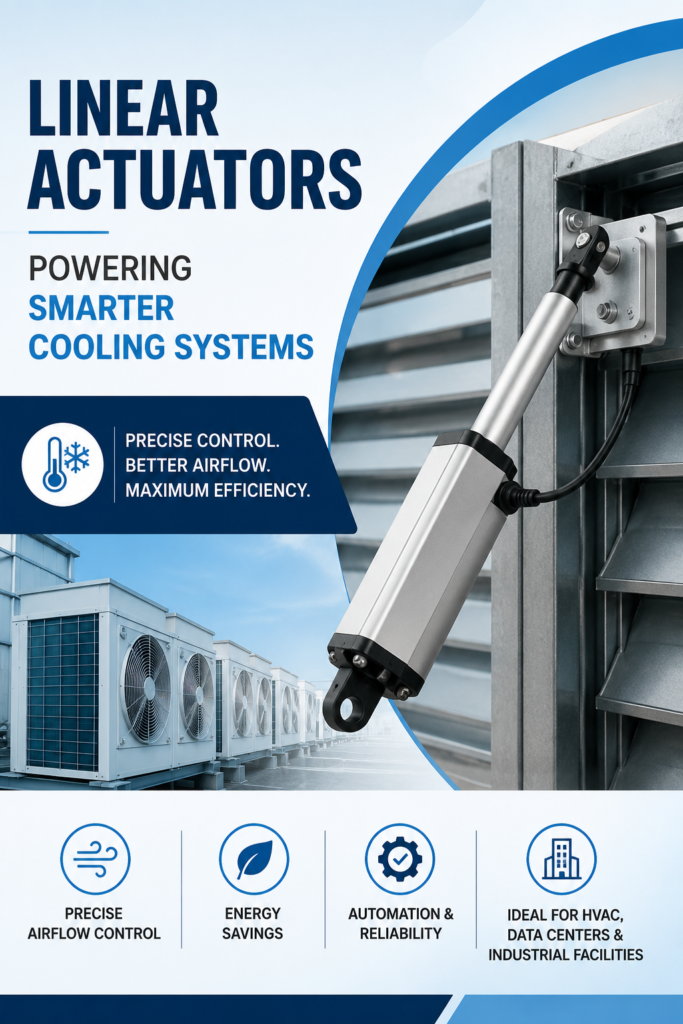
Whether used in HVAC systems, data centers, warehouses, or industrial cooling applications, linear actuators help ensure that cooling equipment responds accurately to changing environmental conditions while reducing manual intervention.
Overview & Key Aspects of Linear Actuators in Cooling Systems
A linear actuator is an electromechanical device that creates straight-line motion to move, position, open, close, raise, or lower cooling system components.
Typical Location
Linear actuators are commonly installed:
- Between the cooling unit frame and adjustable louvers
- On damper assemblies
- On ventilation control systems
- On misting assemblies
- On automated airflow control mechanisms
Primary Function
Their primary purpose is to:
- Raise cooling panels
- Lower ventilation components
- Open dampers
- Close louvers
- Adjust airflow direction
- Control cooling coverage
Key Features of Cooling System Linear Actuators
Features Include:
- Precise Position Control
- Automatic Operation
- Remote Monitoring Capability
- Weather-Resistant Designs
- High Load Capacity
- Low Power Consumption
- Long Service Life
- Smart Sensor Integration
Why These Features Matter
These capabilities help cooling systems:
- Maintain optimal temperatures
- Improve energy efficiency
- Reduce maintenance requirements
- Increase equipment lifespan
Visual Suggestion
📊 Image/Graph: “Linear Actuator Installed on HVAC Damper Controlling Airflow Distribution”
How Linear Actuators Work in Cooling Systems
The operation is straightforward yet highly effective.
Step 1: Receive Command
The control system sends a signal to the actuator.
Step 2: Convert Energy Into Motion
The actuator motor converts electrical energy into linear movement.
Step 3: Move Cooling Component
The actuator:
- Opens louvers
- Adjusts dampers
- Raises cooling panels
- Positions misting systems
Step 4: Maintain Desired Position
Built-in feedback systems ensure accurate positioning.
Step 5: Continuous Monitoring
Sensors monitor:
- Temperature
- Airflow
- Humidity
- Equipment status
The actuator adjusts automatically as conditions change.
Required Components
A complete cooling actuator setup generally includes:
| Component | Purpose |
|---|---|
| Linear Actuator | Creates motion |
| Controller | Sends commands |
| Power Supply | Provides electrical power |
| Sensors | Monitor conditions |
| Mounting Brackets | Secure installation |
| Feedback System | Position verification |
| Wiring & Connectors | Communication and power |
Operations & Functions
Linear actuators perform several important operations:
Airflow Control
- Open air vents
- Close air vents
- Regulate airflow volume
Temperature Regulation
- Direct cooling where needed
- Reduce hot spots
Ventilation Management
- Improve air circulation
- Maintain indoor air quality
Cooling Coverage Adjustment
- Position cooling equipment dynamically
- Improve cooling efficiency
Comparison Table: Manual vs Linear Actuator Controlled Cooling Systems
| Feature | Manual System | Linear Actuator System |
|---|---|---|
| Adjustment Speed | Slow | Fast |
| Accuracy | Moderate | High |
| Energy Efficiency | Lower | Higher |
| Labor Requirement | High | Low |
| Remote Control | No | Yes |
| Automation | Limited | Full |
| Maintenance Monitoring | Minimal | Advanced |
Key Application Areas & Reasons
1. HVAC Systems
Reason:
Precise airflow and temperature management.
Applications:
- Air handling units
- Dampers
- Ventilation systems
2. Data Centers
Reason:
Protect servers from overheating.
Applications:
- Hot aisle containment
- Cooling vent adjustments
- Automated airflow balancing
3. Warehouses
Reason:
Maintain consistent temperatures.
Applications:
- Ventilation control
- Exhaust systems
- Cooling zone management
4. Industrial Cooling Systems
Reason:
Protect machinery and processes.
Applications:
- Process cooling
- Equipment cooling
- Environmental control systems
Visual Suggestion
📈 Graph: “Energy Savings Achieved Through Automated Actuator-Based Cooling Control”
Key Benefits & Specifications
Benefits
- Improved cooling efficiency
- Reduced energy costs
- Better airflow management
- Increased equipment lifespan
- Reduced manual labor
- Faster response times
- Enhanced system reliability
Common Specifications
| Specification | Typical Range |
|---|---|
| Stroke Length | 50mm – 1000mm |
| Voltage | 12V, 24V, 48V, AC |
| Load Capacity | 100N – 10,000N+ |
| Speed | 5–100 mm/s |
| Protection Rating | IP54–IP69K |
| Duty Cycle | 10%–100% |
Steps to Follow When Selecting a Cooling System Linear Actuator
Step 1
Determine required load capacity.
Step 2
Calculate stroke length.
Step 3
Identify environmental conditions.
Step 4
Choose appropriate speed.
Step 5
Verify mounting requirements.
Step 6
Ensure controller compatibility.
Step 7
Confirm protection rating requirements.
Advantages and Disadvantages
Advantages
✔ Precise positioning
✔ Automated operation
✔ Improved energy efficiency
✔ Reduced maintenance costs
✔ Remote monitoring support
✔ Increased safety
Disadvantages
✘ Initial installation cost
✘ Requires power source
✘ Electronic components may require periodic inspection
✘ Environmental protection requirements in harsh conditions
Technology Trends in Cooling System Automation
Modern cooling systems increasingly use:
Smart IoT Integration
- Real-time monitoring
- Predictive maintenance
AI-Based Cooling Optimization
- Automatic airflow balancing
- Energy optimization
Wireless Control Systems
- Remote operation
- Mobile monitoring
Advanced Feedback Sensors
- Higher positioning accuracy
- Faster response times
Key Prevention Techniques
To maximize actuator life:
- Perform regular inspections
- Check mounting hardware
- Monitor electrical connections
- Keep moving parts clean
- Prevent overloading
- Use proper weather protection
- Follow manufacturer maintenance schedules
Compliance and Best Practices
Organizations should:
- Follow HVAC industry standards
- Maintain electrical safety compliance
- Use certified components
- Implement preventive maintenance programs
- Document inspection activities
- Train maintenance personnel
Cooling System Linear Actuator Checklist
Before installation, verify:
- Correct load capacity
- Proper stroke length
- Suitable operating voltage
- Environmental protection rating
- Controller compatibility
- Mounting space availability
- Sensor integration requirements
- Maintenance accessibility
- Emergency operation capability
- Compliance requirements met
Recommended Internal Resources
- Linear Actuator Shop Home
- Industrial Linear Actuators
- Heavy Duty Linear Actuators
- Actuator Accessories
- Linear Actuator Guides & Resources
Frequently Asked Questions (People Also Ask)
1. What is a linear actuator in a cooling system?
A linear actuator is a device that creates straight-line motion to control dampers, louvers, vents, and cooling equipment positions.
2. Why are linear actuators used in HVAC systems?
They automate airflow control, improve energy efficiency, and maintain consistent temperatures.
3. Can linear actuators reduce cooling costs?
Yes. By optimizing airflow and cooling distribution, they help reduce energy consumption.
4. Are linear actuators suitable for data centers?
Absolutely. They help maintain proper server temperatures through automated airflow management.
5. What maintenance do cooling system actuators require?
Routine inspections, lubrication where applicable, electrical checks, and cleaning.
6. How long do linear actuators last?
High-quality actuators can last several years depending on usage, load, and maintenance practices.
7. What protection rating should be used for outdoor cooling systems?
Typically IP65 or higher, depending on environmental exposure.
8. Can actuators be integrated with smart building systems?
Yes. Most modern actuators support automation and building management system integration.
9. What is the ideal actuator load capacity?
The actuator should exceed expected operating loads by approximately 20–30%.
10. Which industries commonly use cooling system actuators?
HVAC, manufacturing, warehouses, data centers, agriculture, and industrial processing facilities.
Conclusion
Linear actuators have become a critical component of modern cooling systems, providing precise control over airflow, ventilation, and cooling coverage. From HVAC installations and warehouses to industrial facilities and data centers, these devices improve efficiency, reduce energy consumption, and support smarter automated operations. By selecting the right actuator, following best practices, and implementing preventive maintenance, organizations can significantly enhance cooling performance while extending equipment life.
0 responses to “Cooling System Airflow Control Made Easy with Linear Actuator Technology”