
When Priya, an automation engineer in Chennai, started working on a new pick-and-place system, she had one major challenge — selecting the right electric actuator. There were so many options: compact, high-force, programmable, ball-screw, belt-driven… she felt lost in the details.
But like any engineer with real-world pressure, Priya needed a practical way to choose the best actuator without wasting time or budget.
So how did she do it? Let’s walk through her process — and yours too.
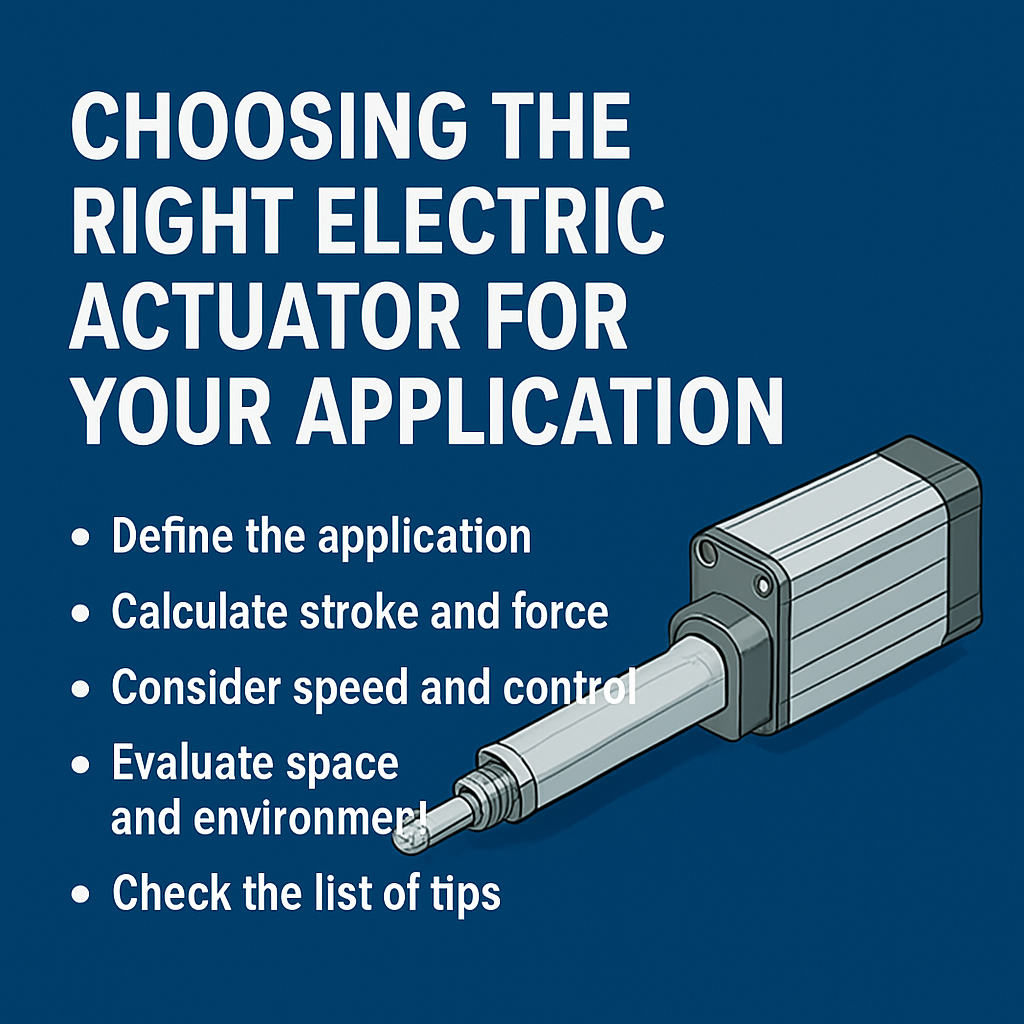
Step 1: Define the Application Clearly
Before you open a catalogue or search online, take a pause and answer these:
- What am I moving?
- How far does it need to move?
- How often does it need to move?
- In what environment will it operate?
In Priya’s case, she needed to move a sensor housing 150 mm, 20 times per minute, in a clean indoor lab. That ruled out pneumatic cylinders and oversized hydraulic setups. Electric actuator? Perfect.
Step 2: Calculate the Required Stroke and Force
Every actuator selection starts with stroke length and force.
Stroke = Distance the load needs to travel
Force = Load mass × gravity (plus margin for friction/resistance)
If the system moves vertically, remember to factor in lifting force. If horizontal, focus on overcoming inertia and friction.
Step 3: Speed, Duty Cycle and Control
Actuators aren’t just about strength and distance — you also need to consider:
- Speed: How fast does it need to extend/retract?
- Duty cycle: How frequently will it operate (e.g., 10%, 50%, 100%)?
- Control: Do you need simple on/off, or position feedback and programmability?
For Priya, the system needed precision — so she went with a ball-screw actuator with encoder feedback.
Step 4: Space, Mounting and Integration
Space constraints can eliminate half your options. Always check:
- Mounting orientation (horizontal, vertical, angled)
- Length of the actuator (especially when fully extended)
- Connector types and motor compatibility
Tip: Compact actuators like those from Kathir Sudhir Automation can be built to your exact specs — stroke, length, mounting, and motor configuration.
Step 5: Consider the Environment
Is the actuator exposed to:
- Dust or moisture? Choose IP-rated designs
- Corrosive chemicals? Go for stainless-steel housing
- High temperatures? Check thermal resistance
Environmental compatibility ensures longer lifespan and reliability.
Why Localised Actuators Make a Difference
When Priya chose an imported actuator, she waited 4 weeks for delivery and got stuck during installation. The next time, she went for an indigenised actuator from Kathir Sudhir Automation — got it in 5 days, with full technical support and easy service.
Sometimes, local is smarter.
Final Selection Checklist
Before you buy:
- Application is clearly defined
- Stroke and force are calculated
- Speed and duty cycle matched
- Control system is compatible
- Mounting and environment are considered
- Vendor offers support and flexibility
Conclusion
Choosing the right electric actuator isn’t about picking the most powerful one — it’s about matching the motion to the mission.
Like Priya, once you ask the right questions and understand the parameters, the perfect actuator becomes clear.
FAQ
1. How do I choose the right electric actuator for my application?
To choose the right electric actuator:
- Define what you are moving (load type and weight)
- Calculate required stroke length
- Determine force needed (including friction and gravity)
- Check speed and duty cycle requirements
- Evaluate control needs (basic or precision positioning)
- Consider mounting space and environment
The best actuator is not the strongest — it’s the one that precisely matches your motion requirements.
2. What factors should I consider before selecting an electric actuator?
Key factors include:
- Load weight and direction (vertical/horizontal)
- Stroke length
- Required speed
- Duty cycle (how often it operates)
- Precision and feedback needs
- Environmental conditions (dust, heat, moisture)
- Available installation space
Ignoring any of these can lead to oversizing, overheating, or premature failure.
3. How do I calculate the force required for an electric actuator?
Basic force calculation:
- Horizontal movement:
Force = Load × friction factor - Vertical lifting:
Force = Load × gravity (9.81 m/s²) + safety margin
Always add a 20–30% safety margin to ensure reliable performance and longer actuator life.
4. What is stroke length in an electric actuator?
Stroke length is the total distance the actuator shaft travels from fully retracted to fully extended.
For example, if your load needs to move 150 mm, your actuator must have at least a 150 mm stroke — preferably slightly more for safe operation.
5. Which is better: ball screw or belt-driven actuator?
It depends on your application:
- Ball screw actuators
- High precision
- High force
- Ideal for vertical lifting and accurate positioning
- Belt-driven actuators
- Faster movement
- Better for long strokes
- Suitable for pick-and-place or horizontal systems
Choose based on accuracy vs. speed requirements.
6. What duty cycle should I select for my electric actuator?
Duty cycle refers to how long the actuator runs compared to rest time.
- 10–25% → Light, occasional movement
- 50% → Moderate automation
- 100% → Continuous industrial operation
If your actuator runs 20 times per minute continuously, ensure it supports higher duty cycles to avoid overheating.
7. When should I use an electric actuator instead of pneumatic or hydraulic cylinders?
Choose electric actuators when you need:
- Precise position control
- Programmable motion
- Clean operation (no air/oil leaks)
- Energy efficiency
- Quiet performance
Electric actuators are ideal for labs, clean environments, and automated pick-and-place systems.
8. How does the environment affect actuator selection?
Environmental conditions directly impact lifespan and performance.
Consider:
- Dust → Choose sealed/IP-rated actuator
- Moisture → Use corrosion-resistant housing
- Chemicals → Stainless steel construction
- High temperature → Check thermal ratings
Selecting the wrong enclosure rating can lead to frequent failures.
9. Why is local manufacturing better for actuator procurement?
Local actuator suppliers offer:
- Faster delivery
- Easier customization
- Technical support
- Faster service and spare parts availability
- Lower downtime
For time-sensitive automation projects, local sourcing can significantly reduce project delays.
10. What common mistakes should I avoid when selecting an electric actuator?
Avoid these common errors:
- Ignoring duty cycle limits
- Underestimating required force
- Choosing actuator only based on price
- Not considering mounting space
- Skipping environmental factors
- Not planning for future scalability
Proper calculation and planning save both time and budget.

Thank god, I have to select a Right Actuator.